

Forward testing and backtesting answer related but different questions. Start with when the information became available and how the trades were executed. A historical simulation can explore years of past conditions. A real-time test makes decisions as new information arrives. Both can still depend on assumptions that deserve careful inspection.
The useful outcome is a clearer evidence record. A profitable chart alone does not establish that a strategy is executable, repeatable or appropriate for anyone’s money. This guide separates the testing stages and shows what to record before moving between them.
Forward testing and backtesting: define the labels first
A backtest applies specified rules to historical data. Researchers use it to investigate the behavior of a proposed strategy and to check implementation. If the rules or settings were chosen using those same results, the period is part of development, often called in-sample research.
A historical out-of-sample test applies previously fixed rules to a reserved later period. That period provides a more useful challenge when its results have not already guided the strategy. Looking at it repeatedly and changing the rules gradually turns it into development data.
In everyday discussion, forward testing often means running a strategy as new data arrives, either on paper, in a demo account or with actual orders. However, platform terminology differs. MetaTrader 5’s Strategy Testing documentation describes a Forward setting that reserves the later part of a historical date range. Selecting it does not by itself create a real-time demo test.
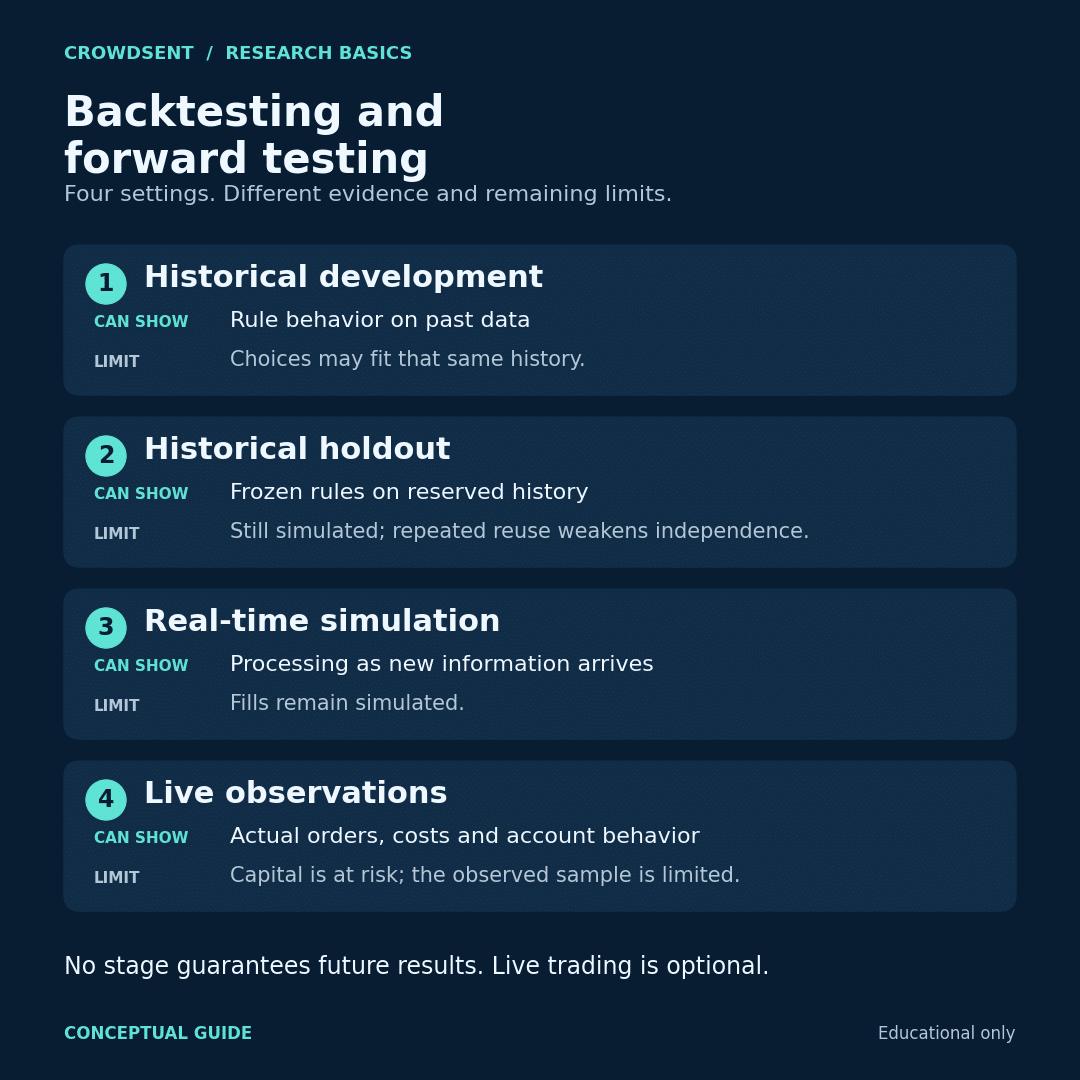
Label every report with its actual environment: historical development, historical holdout, real-time simulation or live execution. This prevents two very different records from being presented under the same word.
What each stage can help you establish
Historical development: does the proposed rule behave as intended?
Inspect individual decisions before focusing on total return. Check that entries follow the stated signal, exits follow the specified rule, and position sizes use the correct units. A long history can help reveal how the rule behaves across different conditions, but additional years cannot repair a timing error or an unrealistic fill assumption.
Save the strategy version, instruments, data source, dates, fees and execution assumptions. If you cannot reproduce the trade list, interpreting the headline statistics becomes much harder.
Historical holdout: does the frozen idea survive a new period?
Write down the selection rule and acceptable research criteria before opening the holdout. Criteria might include correct operation, an understandable loss profile and behavior consistent with the strategy’s explanation. There is no universal return or drawdown threshold that proves a strategy works.
A disappointing holdout is information. If you revise the strategy after reviewing it, record a new version and acknowledge that this period informed development. Calling the revised run untouched would overstate the evidence.
Real-time simulation: does the process work as events arrive?
A prospective test can expose delayed data, missing updates, duplicate signals, connection failures and manual steps that historical code did not model. Keep a contemporaneous log rather than reconstructing decisions from the final chart.
Simulated fills remain simulated. For example, Interactive Brokers’ paper-account documentation says its paper orders do not execute on an exchange and identifies limitations including top-of-book simulated fills and differences in some order behavior. Other environments have their own rules, so review the documentation for the specific account used.
Live observations: what actually happened under real exposure?
Actual orders reveal realized execution and account behavior for those particular orders and conditions. They also put money at risk. A small live record cannot establish future profitability, capacity at a larger size or resilience during events it has never encountered.
Live trading is not a required educational exercise. Research can stop at simulation. Any decision to expose capital requires separate consideration of suitability, financial circumstances and the possibility of loss.
A hypothetical comparison without changing three things at once
Suppose a researcher develops a once-per-day signal during January through December of a fictional Year 1. The rule uses only information available after the close and schedules any order for the next session. They freeze version A before examining January through March of Year 2.
The holdout produces 24 entries. The researcher then runs version A in a demo environment during April and logs 8 entries. The demo gain is smaller than the earlier monthly average. That comparison alone cannot identify a problem: April is a different period with different opportunities.
A more informative check replays April with the frozen historical engine and compares the same dates. Suppose the replay identifies 8 entries, but the real-time log shows one signal arrived too late and another was duplicated after a restart. Those are concrete operational differences to investigate.
Next compare order intent with execution assumptions. If the replay assumes a purchase at 100.00 while the demo records 100.06, the 0.06 difference per unit needs an explanation. It could reflect quote timing or the simulator’s fill rules. It should not automatically be called measured live slippage.
All numbers in this example are hypothetical. The point is to reconcile the sequence: information, signal, intended order, simulated fill and account result. A final profit comparison compresses these steps and can hide the actual cause.
Build an evidence checklist before starting
- Freeze the specification: signal timing, instruments, sizing, exits, restrictions and restart behavior.
- Name the dataset: provider, timezone, coverage, revisions and treatment of missing records.
- Separate selection from evaluation: identify every period that influenced the rules.
- Specify costs: spread treatment, commissions, financing and any additional execution assumptions.
- Keep comparable records: log intended and observed actions with timestamps and strategy version.
- Choose review triggers: include data failure, duplicate orders and unexplained discrepancies, alongside performance observations.
- Retain unsuccessful runs: an evidence record should show how the current version was selected.
Use a market research journal to retain the reasoning behind revisions. When quotes differ across environments, review the bid-ask spread and the timestamp of each side before comparing prices.
How to read a test result honestly
Summarize the conditions the strategy actually encountered. Include exposure, trade count, losses, downtime and periods with no signals. One unusually favorable event can dominate a short sample; many highly similar trades can still provide narrow evidence.
Then separate what was observed from what remains assumed. “The program processed every scheduled update during this demo period” is a testable statement. “The strategy is ready for every market condition” goes well beyond that observation.
If a result needs further work, state the next question precisely. For example: does the discrepancy disappear when both engines use the same quote timestamps? That question creates a useful investigation instead of another round of unrestricted tuning.
Frequently asked questions
1. Is forward testing always done with live money?
No. It can refer to a historical holdout, a prospective paper record or a demo account, depending on the context. Specify the data period and execution environment. Real-money execution is a separate category and carries actual financial risk.
2. Is a backtest useful before the strategy is complete?
Yes, as development evidence. Early tests can reveal coding errors, unrealistic assumptions or behavior inconsistent with the research idea. Label exploratory runs clearly, and do not later describe those same observations as an independent evaluation of the finished version.
3. How long should a prospective test last?
There is no reliable universal duration. Relevant considerations include signal frequency, holding period, operational events and the range of conditions observed. Define the questions the test should answer, then report remaining gaps rather than treating a calendar milestone as proof.
4. Why can demo results differ from a historical replay?
Potential causes include different data timestamps, spreads, fees, sizing, fill assumptions and software behavior. Compare the same period and the same strategy version at the decision level. Different calendar periods add market variation, making the source of a difference harder to identify.
5. Does using historical real-tick data guarantee realistic fills?
No. Price history is only one input to a simulation. The order model, latency assumptions, available liquidity and account constraints still matter. MetaTrader 5 documents several data and execution modes; the chosen configuration should be disclosed alongside the result.
6. Can I adjust a strategy during a demo test?
You can, but record the change and start a separately labeled evaluation segment. Combining results from several evolving versions into one supposedly fixed-strategy track record obscures what was tested and which observations influenced later decisions.
7. Should I compare only net profit?
No. Also compare decisions, exposure, losses, costs and operational incidents. Two records can finish with similar profit while taking very different risks or making different trades. A matching total can therefore conceal a significant implementation problem.
8. What if the strategy makes no trades?
Check whether the rules genuinely produced no signals or whether missing data, permissions or a software error prevented action. A quiet period can establish useful operational facts, but it supplies little direct evidence about entry, exit or execution behavior.
9. Can a manual trading idea be tested prospectively?
Yes, if the decision rules and recording method are explicit enough to audit. Timestamp the information available and the intended action before observing the outcome. Record skipped opportunities too; otherwise hindsight can influence which decisions appear in the record.
10. What should I ask when someone shares a successful test?
Ask which period was used, whether it informed development, how many versions were tried, what costs were included and whether fills were simulated. Request the underlying decision record where appropriate. A screenshot rarely answers these questions on its own.
Keep the next research step proportionate
To explore the workspace and its membership options, open CrowdSent.
Educational information only, not financial or investment advice. Examples are hypothetical. Historical and simulated results do not guarantee future outcomes, and trading can cause substantial losses.