

CrowdSent Blog Team · Policy-source literacy
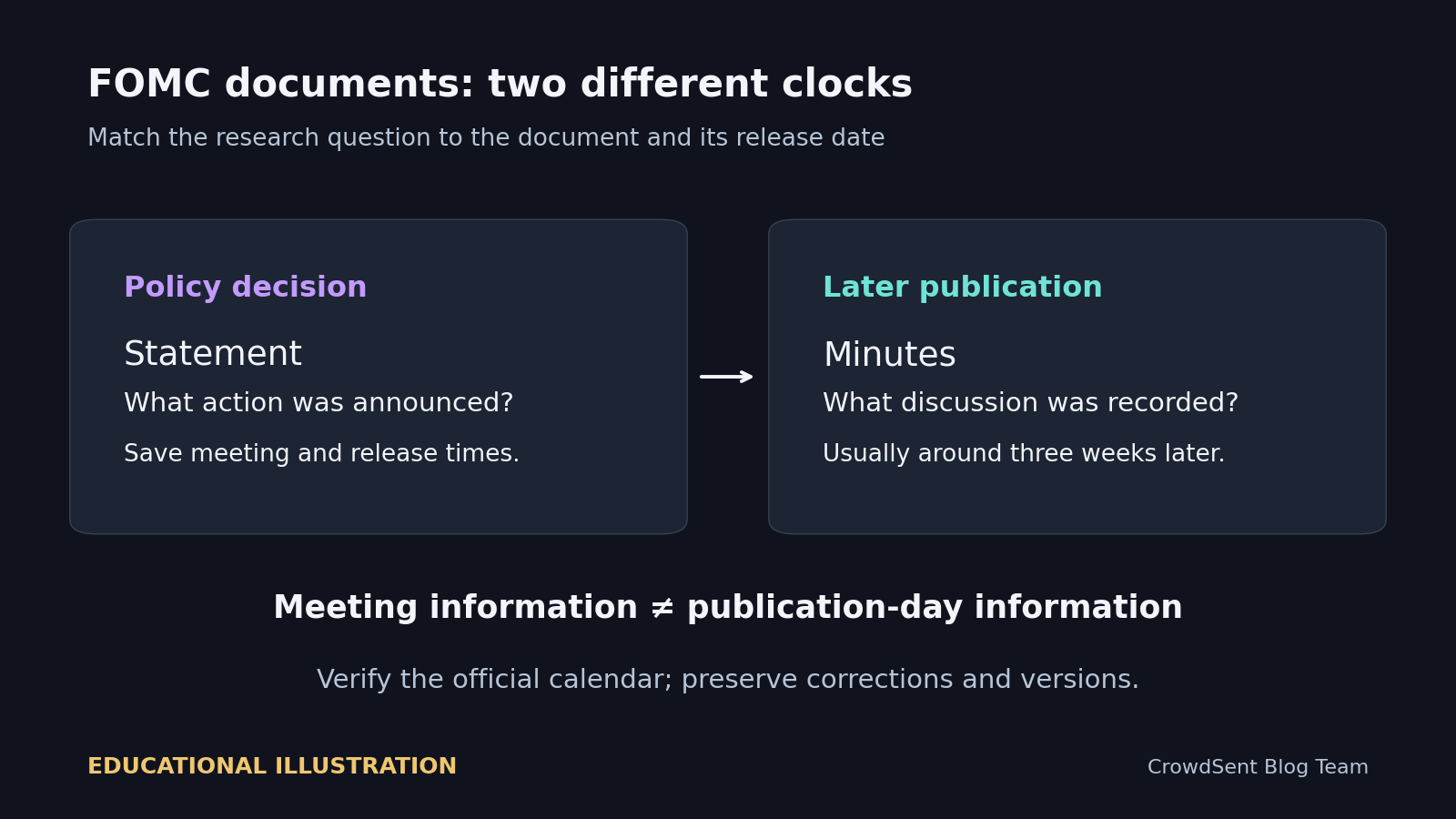
FOMC statement vs minutes is a question about purpose and timing. The statement announces the Federal Open Market Committee’s policy decision. The minutes provide a later account of the meeting’s discussion and decisions. Start with the statement when checking what was announced; use the minutes when investigating the reasoning and range of views recorded for that meeting.
Both documents belong to the US Federal Reserve. Readers in India and Pakistan may use them as sources for global currency or metals research, while keeping local observations and institutions separate. A US policy publication does not by itself explain a change in an INR or PKR quotation.
This guide shows how to select policy announcement sources, preserve release dates and avoid reading later knowledge back into an earlier event. It contains no current policy forecast. The worked research exercise is fictional, and the real archived documents are included only to demonstrate how to locate and label a source.
1. Turn the FOMC statement vs minutes question into a precise task
Ask what evidence would settle your question. “What decision was announced?” calls for the statement attached to that meeting. “What concerns did participants discuss?” calls for the corresponding minutes. “What did a speaker say during questions?” requires the relevant press-conference record, with its own timestamp and attribution.
The Federal Reserve’s guide to historical FOMC materials distinguishes policy statements, minutes, transcripts and projection materials. Minutes summarise significant meeting issues and reasoning; a transcript is the more detailed record of proceedings. The Summary of Economic Projections is a separate compilation of participants’ projections. Keep these document types labelled when assembling evidence.
Write a one-line research question before collecting extracts. For example: “Did the public decision announcement include a change to the stated action?” Or: “Which considerations were recorded as relevant to that decision?” A broad question such as “Was the meeting positive?” makes it too easy to select whichever sentence fits an existing impression.
Also identify the comparison. You may be comparing consecutive statements, comparing one statement with its own minutes, or comparing news summaries with the original documents. Each uses a different baseline. Comparing last month’s statement with this month’s minutes without noticing the meeting dates combines two separate changes: document type and meeting period.
Give your note a neutral working title. “Differences between two dated statements” is more precise than a market-direction label before the evidence is read. This keeps the research useful even if the final conclusion is simply that the available wording does not answer the question.
2. Read the statement for the announced action
Find the statement through the official meeting entry, then record its title, release date and displayed time. Read the complete text before relying on a highlighted sentence. Separate descriptions of economic conditions from the action announced, any conditions attached to future assessment and the recorded vote.
The archived statement dated 17 September 2025 is a concrete example of the source format. It presents a dated policy announcement with economic context and voting information. It is an historical reference here, not a statement of the current policy setting. No rate figures from it are reproduced in this guide.
For a comparison between meetings, place the two statements side by side and mark additions, deletions and changed numbers. Preserve the surrounding sentence. A removed adjective may matter, but its meaning depends on what replaced it and whether the subject of the sentence stayed the same.
Keep three fields in your working note: exact source location, your plain-language paraphrase and the inference you are considering. These fields should remain distinguishable. “The statement contains this action” is a source observation. “This action will cause a particular currency move” is a separate proposition requiring evidence beyond the statement.
Avoid treating an unchanged rate number as proof that the whole document is unchanged. Conversely, a revised description does not automatically imply that every operational setting changed. Check the actual action language and any accompanying implementation document relevant to your question.
If a news article attributes a claim to “the Fed,” use the market-news verification process to locate the precise document or speaker. The institution’s name alone is too broad an attribution for a reproducible comparison.
3. Read the minutes with the subject of each passage intact
Start with the meeting dates in the minutes’ header. Then identify the section that answers your question. A paragraph reviewing market developments, a staff economic outlook and a passage discussing participants’ views are different kinds of evidence. Preserve those labels rather than merging them into one institutional opinion.
The minutes of the 16–17 September 2025 meeting illustrate that structure, with sections covering financial developments, staff assessments, participant discussion and policy action. The document describes information associated with that meeting. Its later availability does not transform every recorded assessment into a fresh view formed on publication day.
For each relevant passage, ask: who is the grammatical subject, what period is discussed, and how conditional is the claim? Keep terms such as “some,” “several,” “most” or “all” attached to the group named in the text. Do not convert qualitative wording into an invented headcount or voting tally.
Distinguish a discussion from an adopted decision. Participants can consider an option without the committee choosing it. A sentence about uncertainty can explain the setting for a decision without specifying the outcome of a future meeting. Read the eventual action and vote separately before writing a summary.
A useful extraction record contains a short paraphrase, the section heading, the meeting date, the release date and a link to the complete document. Add the nearby qualification if omitting it would change the meaning. Avoid collecting isolated phrases merely because they resemble a familiar market label.
When interpretations from a discussion group conflict, compare their source passages first. The guide to evaluating trading-community discussions helps separate a documented observation from a confident but unsupported extension of it.
4. Keep meeting time, publication time and local time separate
The official FOMC meeting calendar links each meeting to its available documents and says minutes of regularly scheduled meetings are released three weeks after the policy decision. Verify the actual entry for the event you are researching. A general publication convention should never substitute for the listed release date or a later notice.
Maintain at least three dates: when the meeting occurred, when the document became public and when you collected it. The first describes the discussion’s setting. The second matters for what an outside researcher could have known. The third records your retrieval and can help identify a later version.
The archived September example makes the distinction visible: the meeting ended on 17 September 2025, while its minutes were released on 8 October 2025. A note about information publicly available on the meeting day cannot use the minutes as though they had already been published.
For India and Pakistan, retain the source time zone and a converted local timestamp, including the date. If an explicitly hypothetical release occurred at 18:00 UTC, it would be 23:30 in India and 23:00 in Pakistan that day. If it occurred at 19:00 UTC, the Indian time would fall on the next calendar day.
Do not assume one fixed conversion from a US Eastern clock label throughout the year. Identify the offset that applied to the actual timestamp, or convert with a date-aware time-zone tool. Store an unambiguous UTC timestamp alongside the local display when possible.
This also matters for chart comparisons. A daily price bar labelled with a local date may cover a different interval from a US-dated release. Confirm the bar’s session boundary before describing it as the observation “after the announcement.” The date printed beneath a chart is only one part of the timing record.
5. Separate document corrections from revised economic data
There are two different version questions. First, did the policy document itself change after its initial publication? Second, did an economic series mentioned in the document receive later revisions? Keep separate fields for these issues rather than calling both of them “updated minutes.”
If a page shows an update date, inspect any correction note and compare the relevant passages with the copy you saved. An update timestamp alone does not tell you which substantive wording changed. Record the difference you can verify and leave the reason unresolved if the source does not explain it.
For economic data, preserve the release version available at the meeting. A later revision can improve today’s description of the earlier economy while still being information participants could not have had at the time. Replacing the older figure silently would change the research question from contemporary decision context to retrospective assessment.
Hypothetical revision exercise: your fictional meeting note records a growth estimate of 2.0%. A later statistical release revises that same period to 1.7%. The revision is negative 0.3 percentage points. Record both values with their respective release dates; do not rewrite the original note to imply that 1.7% was already known.
Then add a second sentence: “The later estimate changes the retrospective description, but this note’s meeting-time record retains the earlier release.” This wording makes the difference clear without defending or criticising a policy decision. The exercise concerns version control, not an actual economic release or an evaluation of a central bank.
Save your original files with readable names containing document type, meeting date and retrieval date. If a correction is found, add a new version and a short change log. Reproducibility is easier when the source history is visible than when one file is repeatedly overwritten.
6. Build a short evidence note without a policy forecast
Hypothetical source-audit case: a fictional social post says that minutes published today prove officials changed their view today. You open the underlying document and find that its header refers to a meeting held several weeks earlier. Your first correction is temporal: the post has confused the publication of an account with the date of the recorded discussion.
Next, locate the passage supporting the claim. Suppose it appears in a fictional staff-outlook section, while the post attributes it to every voting member. Your second correction is attribution. Preserve the passage’s actual subject and avoid replacing one exaggerated claim with an equally broad statement about the committee.
Finally, ask whether the document supports the claimed change. A comparison needs an earlier, compatible baseline. If the post supplies no previous staff outlook or corresponding passage, the evidence may establish what the fictional document says while leaving the claimed change unverified.
A concise result would read: “The linked minutes describe an earlier meeting. The cited passage concerns the staff outlook. The post’s claim of a same-day change by all voting members is not established by that passage.” Nothing in this conclusion requires a prediction about the next decision or a currency’s direction.
For a local market note, add separate observations for the instrument you are studying: quote currency, provider, time window and any other releases within that window. A US source can be relevant background without being a complete account of an Indian or Pakistani market observation. For a gold-focused example, see what affects gold prices.
Use the market research journal template to retain the question, source, dates, passage, interpretation and unresolved evidence. Finish with the next condition that would justify reopening the note, such as an official correction, a missing source becoming available or a newly released comparable document.
Frequently asked questions
Which document should I open to verify the decision announced after a meeting?
Start with the statement linked to that meeting on the official calendar. Identify the action language and its date before reading a news summary. If your question concerns operational details referenced elsewhere, retain the accompanying implementation material separately. Do not substitute minutes from a different meeting simply because they appear higher in a search result.
Are the minutes a word-for-word transcript?
The minutes are a summary record of significant issues, reasoning and decisions. A transcript is a separate, more detailed document type. When a question depends on exactly who said a particular sentence, check whether the source actually attributes it. Do not turn an unattributed summary of participants’ views into a quotation from a named person.
Does the minutes release announce a new policy decision?
Identify the meeting and any action explicitly described in the release. Publishing an account of an earlier meeting does not, by itself, establish a new decision on publication day. A fresh policy announcement would need its own evidence. Keep the release event and the recorded meeting event separate in both your timeline and your summary.
Can I count the words “some” or “several” as a fixed number of voters?
Those terms do not provide an exact headcount by themselves. They may also describe participants rather than only the members voting at that meeting. Preserve the wording and the named group, then read the recorded vote separately. Converting broad language into precise numbers adds information that the passage has not supplied.
Why can a staff passage differ from the committee’s action?
A staff assessment and a committee decision have different subjects and functions. First confirm which section contains each statement, then describe them with their own attribution. A difference is a research question to examine in context. It is not sufficient evidence that the document contradicts itself or that every participant held the same view.
What should I compare when assessing whether a statement changed?
Compare consecutive statements attached to their correct meeting dates, keeping the complete surrounding sentences. Mark numerical changes, additions and deletions separately. If a passage moved or was shortened, inspect both versions before drawing a conclusion. A change log should show what changed in the text and keep your interpretation in a different field.
Do later revisions make the original meeting record unusable?
The record remains useful for studying what was available and discussed at that time. Preserve the original data vintage, then add the later revision with its release date. Which version belongs in the analysis depends on whether you are examining contemporary information or constructing a retrospective description. State that choice rather than mixing the two silently.
How do I record a release that falls after midnight in India?
Use the full local date and time, the original source time zone and a UTC equivalent. Do not keep only the US calendar date as the local date. For comparisons with market data, check the provider’s session boundaries as well. Two records with different displayed dates may still refer to the same instant.
Can a sentiment label replace reading the underlying document?
A sentiment label is a derived interpretation whose method and text coverage need checking. It cannot identify every qualification, speaker category or publication-date issue on its own. Keep the document as the primary evidence and use any label as a separate annotation. A change in that annotation does not automatically establish a change in policy.
What belongs in a finished FOMC research note?
Include the question, meeting date, document type, release timestamp, source link, relevant passage location, concise paraphrase and any version information. State what the evidence supports and what it leaves unanswered. If the note also discusses a market observation, label that observation separately with its own source and time window rather than implying that timing proves causation.
Source documentation checked 7 October 2026. Educational research guidance from the CrowdSent Blog Team. All hypothetical examples are invented and are not current market data. This article does not provide investment recommendations.