

Ex-dividend date vs record date separates the market’s trading-entitlement cutoff from the issuer’s shareholder-record checkpoint. The ex-dividend date identifies when a purchase normally stops carrying the specified dividend. The record date identifies the shareholder record used for that distribution. They can fall on the same calendar day while doing different jobs.
A third date, payment date, concerns the distribution of money. Confusing any of these can lead to an incorrect entitlement calculation, even when the cash amount per share is copied correctly.
This guide works through an ordinary cash-dividend example, then explains why current notices, local market rules and special distributions can change the timeline. US, India and Pakistan references are checked as of 10 October 2026. The examples explain records; they are not a dividend-capture strategy.
Ex-dividend date, record date and the other event milestones
Declaration or announcement date records when the distribution is announced. Read whether the wording describes a declared interim payment, a board recommendation or a proposal still requiring approval. Those statuses should not be silently treated as identical.
Ex-dividend date is the first date on which the security trades without the specified entitlement under the applicable convention. The preceding eligible trading day is often called the last cum-dividend day. The exact event notice governs; a generic calendar formula cannot override it.
Record date is the issuer’s checkpoint for the shareholder record associated with the event. Payment or payable date identifies when the distribution is scheduled to be paid. The account’s visible credit time may also involve intermediary processing.
Investor.gov’s dividend-date explanation distinguishes the record date from the exchange-rule-based ex-date. For ordinary cases it explains that buying on or after the ex-date does not carry that next dividend, while buying before it does. Special distributions require additional checks.
Copy the event’s year as carefully as its day and month. A company can use similar dates for successive dividends, and a search result may surface an older event. The announcement date, covered financial period and per-share amount help identify which distribution the record concerns.
A worked entitlement example under stated T+1 assumptions
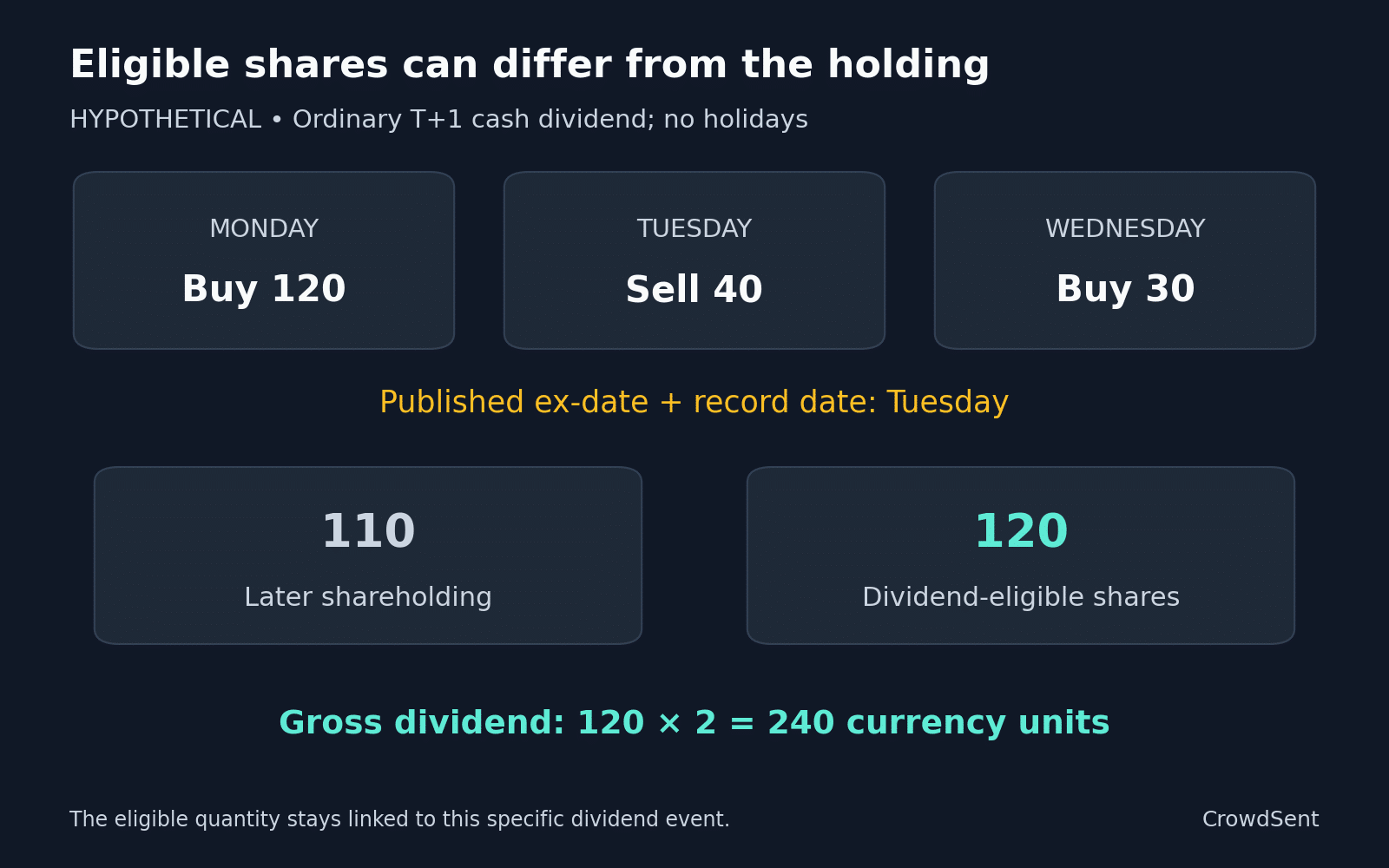
Assume a fictional company declares a cash dividend of 2 currency units per share. Its published ex-date and record date are both Tuesday, and payment is scheduled for a later Friday. Monday and Tuesday are ordinary trading and settlement days. Transactions follow standard T+1 settlement, with no special distribution rules, failed deliveries or other complications.
Reader A buys 120 shares on Monday. Under these assumptions, the purchase settles on Tuesday and carries the dividend entitlement. The gross amount attached to those 120 eligible shares is 120 × 2 = 240 currency units.
Reader B buys 80 shares on Tuesday, the published ex-date. That purchase settles on Wednesday and does not carry this dividend. Reader B’s 80-share position can appear in the account on trade date without making it eligible for the already separated entitlement.
Now suppose Reader A sells 40 of the original shares on Tuesday. Under our ordinary ex-date assumptions, that sale occurs without this dividend attached. Reader A’s entitlement remains associated with the 120 eligible shares, although only 80 shares remain after the sale. The later position size and the dividend-eligible quantity therefore differ.
If Reader A also buys 30 new shares on Wednesday, the account eventually holds 110 shares: 120 − 40 + 30. The specified dividend is still based on 120 eligible shares. Multiplying the eventual 110-share position by 2 would produce 220 and misstate the event entitlement by 20.
This example is about event-linked quantities. It does not establish a favourable return from buying or selling around the dates. Market prices, transaction costs, taxes and subsequent news remain separate, and no arithmetic here predicts them.
The result also depends on the facts we deliberately fixed: the published dates, normal settlement, ordinary cash distribution and eligible share class. Change one of those facts and the entitlement analysis must be revisited instead of reusing 240 automatically.
Why US, Indian and Pakistani records need separate checks
United States: current FINRA Rule 11140 sets out ex-date designation, including normal treatment for distributions below 25% of the security’s value when definitive information arrives in time. It uses the record date when that is a business day, with a specified preceding-day treatment for non-delivery dates. The rule also contains exceptions.
This helps explain why older T+2-era articles can give a different routine relationship between the ex-date and record date. A historical explanation may accurately describe its own period while being unsuitable for a current event. Preserve the rule date when researching older dividends.
India: NSE’s corporate-action record for Infosys provides a concrete example: its INR 25-per-share dividend entry shows 10 June 2026 as both ex-date and record date. That illustrates two separate fields sharing a date. It is not a promise that every future Indian corporate action uses identical dates or mechanics.
For another company or share class, retrieve the corresponding exchange entry and issuer announcement. Match the security identifier, purpose and payment amount. A search snippet that omits the record year or confuses a buyback with a dividend is insufficient evidence.
Pakistan: notices commonly include a share-transfer-book closure period and a transfer-receipt cutoff. A Fatima Fertilizer filing on PSX dated 6 March 2026 separately identifies dividend-related book closure and AGM-related book closure. Its dividend section references the members’ register on 30 March and book closure from 31 March through 2 April.
The distinction prevents using an AGM participation date as a dividend cutoff. Book closure is a period in the issuer’s record process; it should not be renamed “payment date” or automatically treated as the exchange’s ex-date. Obtain the applicable ex-entitlement notice and settlement context when the transaction timing matters.
For a Pakistan-market transaction, an old “subtract two days” shortcut should not substitute for current event records and settlement rules. More generally, readers should not apply US due-bill rules to a Pakistani notice or Indian holiday assumptions to a US listing.
Special distributions can rearrange the usual timeline
The familiar sequence of ex-date, record date and later payment is not universal. FINRA Rule 11140 specifies that certain distributions worth 25% or more of the security’s value have an ex-date on the first business day after the payable date. It also provides separate designation provisions for specified foreign-security situations and late information.
That percentage refers to the value of the security under the applicable rule. It is not automatically the same as a dividend announcement expressed as a percentage of face value. Applying the special-distribution threshold to the wrong denominator could select an entirely wrong timeline.
In some corporate actions, due bills pass the entitlement through to a purchaser even though a different holder appears in the issuer’s record or initially receives the distribution. Investor.gov discusses this issue for stock dividends. A seller should therefore not infer final entitlement merely from having held shares on the record date when a special process applies.
For research, flag unusually large distributions, stock dividends, splits, rights and depositary-receipt events for event-specific review. These labels do not all share one date rule. Keep the announced ex-date and the official instructions rather than improvising a universal exception formula.
Late or revised announcements deserve similar care. If the exchange changes an event date, save the revision and its publication time. A calendar exported before the change can remain internally consistent while no longer describing the effective event.
Reconcile the cash amount without turning dates into a return claim
Once entitlement is established, multiply eligible shares by the stated cash amount per share. In the fictional example, 120 eligible shares at 2 each produce a gross distribution of 240. This quantity calculation is separate from any deductions and from the account balance after later trades.
If an announcement instead says “20% dividend,” identify its base. With a hypothetical face value of 10 per share, 20% of face value equals 2 per share. It does not mean a 20% return on a market purchase price of 200. The terms “percentage” and “dividend” are insufficient without their denominator.
Keep gross entitlement, deductions and actual cash credit in separate columns. If the credit is 228 while gross entitlement is 240, the 12-unit difference needs a documented explanation. This article supplies no assumed withholding rate; a plausible-looking percentage is not proof of why the account differs.
Payment timing also matters. On the record date, the dividend might be an entitlement awaiting a later payment rather than cash already available. A missing credit before the payable date does not by itself establish a processing error. After payment, compare the event notice with the broker or registrar record.
A price movement around the ex-date is a different measurement from entitlement. The share can reflect the separated distribution alongside other market information. The dates alone do not guarantee an exact price change or a profit. Historical price adjustment and total-return calculations require their own methodology, rather than being inferred from this eligibility ledger.
Build a dividend record that survives later changes
Use one row per event and security class. Record issuer, identifier, exchange, currency, event status, cash per share, declaration date, ex-date, record date and payment date. Where relevant, add book closure, transfer cutoff and special entitlement instructions as separate fields.
Then keep an event-linked quantity calculation. Preserve qualifying holdings and relevant transactions instead of multiplying a current position by the dividend amount. Our fictional account’s later 110 shares and its 120 eligible shares answer different questions.
If the issuer and a calendar disagree, inspect revisions and security identifiers before choosing a source. Use the market-news verification process to locate the primary announcement. Keep missing fields visibly unavailable, following the missing-data guidance, rather than filling an unknown payment date with the record date.
Save the event record and source versions in a research journal. A defensible summary names the event, eligible quantity, gross amount and any unresolved deductions or timing. It does not need a forecast about the next share-price move.
Frequently asked questions
1. Can the ex-dividend date and record date be the same?
Yes. They can share a calendar date while serving different purposes. The cited NSE example shows separate ex-date and record-date fields both set to 10 June 2026.
2. Does buying on the ex-date normally include that dividend?
Under the ordinary cash-dividend convention described here, it does not. Check the actual event’s official ex-date and any special rules rather than assuming a position shown on trade date establishes entitlement.
3. Why can I receive a dividend on more shares than I currently hold?
Your eligible quantity relates to the specific event’s cutoff and transaction history. In the example, later sales and purchases leave 110 shares while the ordinary dividend entitlement remains based on 120.
4. Is the record date also the day the money arrives?
Not necessarily. Payment date is a separate field, and intermediary processing may affect the account’s visible credit. Keep entitlement, scheduled payment and actual receipt as distinct milestones.
5. What does book closure mean in a Pakistan notice?
It identifies a specified period for the issuer’s share-transfer books, with related cutoff instructions. A notice can contain different closures for dividend entitlement and AGM participation. Read each purpose separately.
6. Are special-dividend ex-dates always before payment?
No. The cited US rule places certain large-distribution ex-dates after the payable date. This is why a record-date-only shortcut can fail. Follow the event’s official designation and entitlement instructions.
7. Does a 25% declared dividend necessarily trigger the US large-distribution rule?
No. The rule’s threshold concerns security value, while an announcement may express its percentage using face value. Establish both the applicable jurisdiction and denominator before comparing percentages.
8. Does receiving the dividend prove the transaction was profitable?
No. Entitlement and gross cash are only part of the record. Purchase and sale prices, continuing share value, costs and deductions affect the broader outcome. This article does not predict any of them.
9. What if two calendars show different ex-dates?
Check the security class, event year, latest issuer filing and exchange designation. One calendar may contain an older announcement or another corporate action. Preserve revisions instead of guessing which date is newer.
10. What should I compare if the cash credit differs from my calculation?
Check eligible share quantity, cash per share, currency, documented deductions, payment timing and later corrections. Do not replace the eligible quantity with today’s holding or invent a tax rate to explain the difference.
Continue your market research at CrowdSent.
Educational information only. Worked examples are hypothetical. This article does not provide investment, legal or tax advice.