

CrowdSent Blog Team · Market research education
Crypto funding rates describe a contract mechanism that transfers value between the two sides of a perpetual market. Reading the percentage correctly requires the contract, the period it covers, the position-value definition and the payment convention. A rate by itself cannot tell you a cash amount or explain what happens next to an asset’s price.
This guide gives you seven checks for turning a funding-rate screenshot into a traceable calculation. The examples use fictional contracts and amounts so you can concentrate on units and timing. For readers in India and Pakistan, the important localisation step is often matching UTC records to the correct local date, while preserving the original settlement currency.
1. Identify the contract behind crypto funding rates
A perpetual contract has no scheduled expiry in the ordinary sense of a dated futures contract. Its funding mechanism creates transfers associated with keeping the contract’s pricing aligned with its reference. Start with the exact instrument identifier. Two screens showing the same asset name may refer to different venues, quote assets, settlement assets or contract structures.
Write the venue and symbol together, then record whether the instrument is linear or inverse. A linear example may calculate position value by multiplying an asset quantity by a reference price. An inverse example can express the contract face value in one currency and settle the funding amount in the underlying asset. The product’s multiplier and specification determine the conversion.
Keep the contract identifier intact when saving a screenshot. Cropping away the symbol, selected market or settlement label can remove the fields needed to interpret the number. If a chart aggregates multiple contracts, request or locate its constituent list and weighting description before treating it as an individual perpetual funding rate.
Separate the reader’s question from the display’s title. “How is this transfer calculated?” can be answered with a contract specification and event record. “What does every participant believe?” cannot be recovered from the same percentage. This article focuses on the first question.
2. Separate the funding rate from the funding amount
The Bybit funding-fee documentation gives a concrete venue example: funding amounts use position value multiplied by the funding rate. Its linear and inverse examples define position value differently. It also describes positive funding as a transfer from longs to shorts, with negative funding reversing that direction. Those conventions should be checked for the contract being studied.
Think in three labelled fields: percentage, value base and resulting amount. A funding rate of 0.02% is a dimensionless fraction of 0.0002. If the value base is 12,000 fictional settlement units, multiplication gives 2.4 settlement units. The percentage sign supplies a division by one hundred. Omitting that conversion makes the result one hundred times too large.
Choose one account perspective for your notes. For example, define received cash as positive and paid cash as negative. Under that bookkeeping convention, a positive published rate produces a negative cash entry for the long side in the example above. A venue’s statement might instead show charges as positive. Preserve its original sign and add a separate normalised column if necessary.
Never add a rate directly to an amount. “0.02 plus 2.4” mixes unlike units even if both appear in neighbouring cells. Likewise, a coin-denominated transfer cannot be added to a stablecoin-denominated transfer without an explicitly chosen conversion record. Keep original amounts available after any translation.
3. Read the funding interval and the observation time
A percentage needs a time basis. Record whether the field is an estimate for an upcoming event, a completed event rate, an hourly figure or a display scaled to some other interval. Save both the market observation time and the time you collected it. A newly loaded page can still contain an older observation.
Timing conventions genuinely differ. Coinbase’s Global Derivatives funding specifications describe an eight-hour rate display with continuously calculated payments, incorporating a time fraction. That is a useful warning against assuming every eight-hour label means one transfer at an eight-hour boundary. The documentation is a methodological example, without implying product availability for any reader.
Hypothetical comparison: Contract A reports 0.012% per four hours, while Contract B reports 0.018% per eight hours. Under an explicitly constant-rate, constant-value assumption, A’s simple eight-hour equivalent is 0.024%. The numerical ordering changes after aligning the horizon. This arithmetic does not predict the next event or establish that the contracts are otherwise comparable.
For local-time notes, an event at 20:00 UTC falls at 01:30 the next day in India and 01:00 the next day in Pakistan. Keep the date as well as the clock time. A researcher grouping records by a local calendar day may include a different set of events from a source grouped by UTC day.
4. Reproduce a hypothetical funding-fee calculation
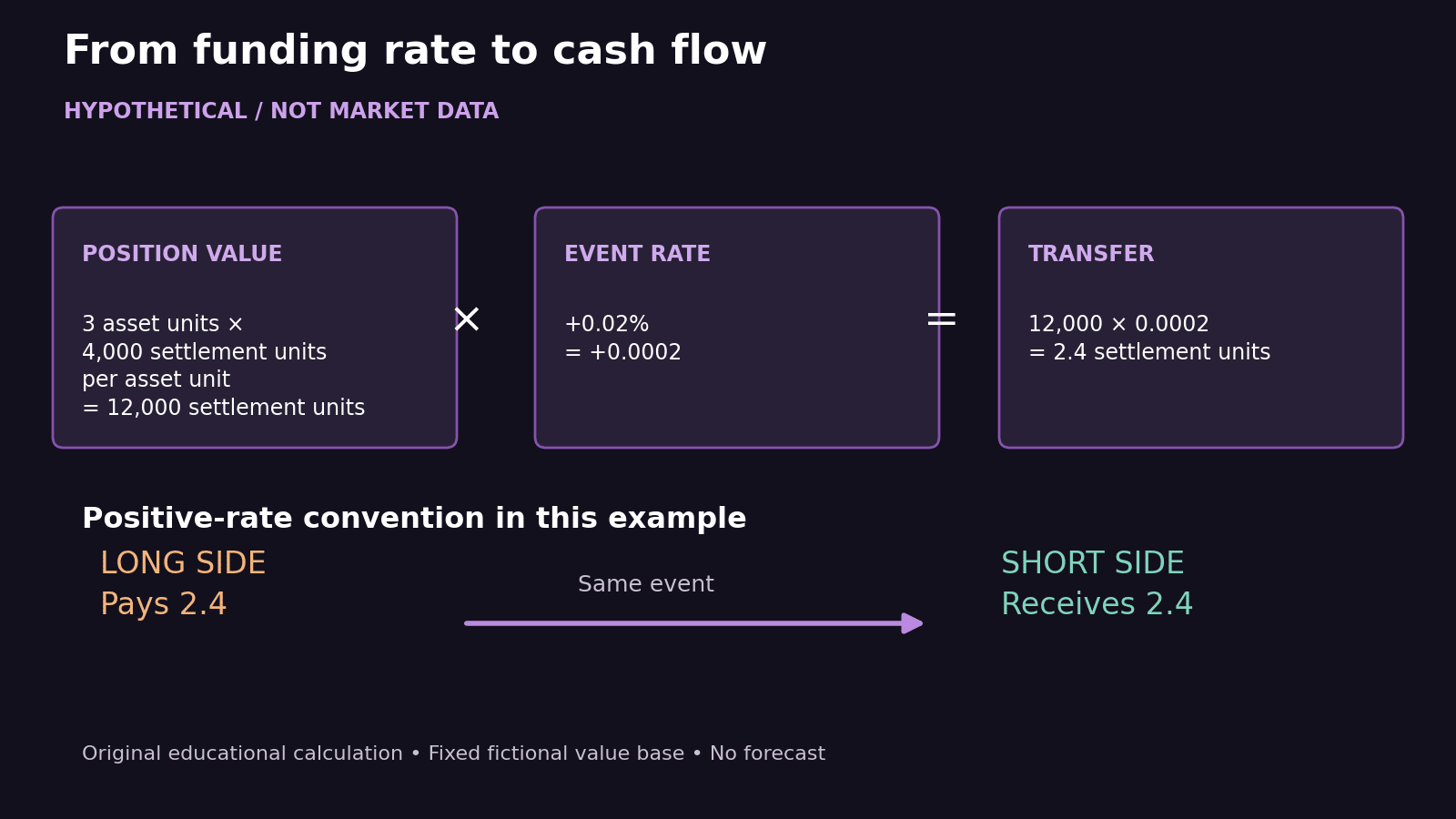
Here is a complete fictional linear-contract example. The position quantity is 3 units of Asset Q. The specified valuation reference at the event is 4,000 settlement units per Asset Q. The final rate is positive 0.02% for that event. The example assumes the position is included under the contract’s event rules; it does not model a real account.
- Position value: 3 Asset Q × 4,000 settlement units per Asset Q = 12,000 settlement units.
- Rate conversion: 0.02 ÷ 100 = 0.0002, the decimal form of 0.02%.
- Transfer magnitude: 12,000 × 0.0002 = 2.4 settlement units.
- Direction: using the stated positive-rate convention, the long side pays 2.4 and the matching short side receives 2.4.
Now change only the rate to negative 0.015%. Its decimal value is negative 0.00015, and the transfer magnitude becomes 1.8 settlement units. Under the same convention, the long receives and the short pays. Changing the rate sign changes the direction; it does not change the position-value unit.
For an independent inverse example, define a fictional contract with a face amount of 6,000 quote units and an event reference of 3,000 quote units per coin. Its stated position-value rule gives 6,000 ÷ 3,000 = 2 coins. At positive 0.01%, the transfer magnitude is 0.0002 coin. These invented specifications deliberately include the unit conversion that a bare contract count would hide.
Keep full precision through intermediate steps, then apply the documented settlement rounding rule. If that rule is unavailable, describe your answer as an unrounded educational calculation. A tiny difference from a statement may require checking precision, the exact event reference, position changes or rounding; do not automatically attribute it to an extra fee.
5. Distinguish the rate formula from the payment formula
The payment calculation starts after the applicable rate has been identified. Producing that rate is a separate process. Bybit’s funding-rate introduction describes interest and premium inputs, time weighting, and upper and lower limits. It also notes that limits and settlement frequency can change. This source illustrates why a remembered default should not replace dated contract documentation.
Make two boxes in your notes. The first records how the provider constructs a percentage: source observations, averaging window, caps and any special instrument treatment. The second records how that percentage becomes a transfer: eligible position value, event or accrual period, settlement unit and rounding. A missing input in either box prevents full reproduction.
For a purely hypothetical capped calculation, suppose a fictional preliminary rate is 0.09% and the published rule restricts the final rate to at most 0.05%. The value used in the payment arithmetic is then 0.05%. This demonstrates a cap, not the settings of a real venue. A different preliminary input above the same cap could produce the same final value.
That many-to-one relationship matters when interpreting screenshots. Identical final percentages can conceal different underlying inputs. Conversely, different final rates can come from different formula settings even when the observed markets seem similar. Retain a dated methodology reference before deciding a difference reflects changed participant behaviour.
6. Reconcile several events without turning them into a forecast
A historical funding total is a sum of actual event amounts in compatible units. If position values vary, a simple sum of percentages will not reproduce the cash-flow total. Recalculate each event first, using its own value base and sign, then aggregate the resulting amounts.
Hypothetical two-event record: a long-side position has a value of 12,000 settlement units at a positive 0.02% event, producing a payment of 2.4. At a later event its value is 9,000, and the rate is negative 0.01%, producing a receipt of 0.9. With receipts positive, the combined cash entry is negative 1.5 settlement units.
The rate sum is positive 0.01%, but multiplying that by the first value gives 1.2, which does not reproduce the total paid. The discrepancy comes from the changed base. A ledger that retains each event makes the error visible immediately. Also distinguish this funding subtotal from any wider account result.
Annualising a single interval adds assumptions about repetition. It can express a common comparison scale, but its label must say that the rate and interval are held constant mechanically. Avoid presenting the result as expected income, an account return or a realised annual cost. This guide does not need annualisation to explain the observed cash flow.
Store the event rows in a market research journal. When revisiting an older record, the historical sentiment comparison guide offers a related discipline: match the observation windows before interpreting differences. Funding remains a contract measure even when discussion around it becomes emotionally charged.
7. Write a funding note someone else can check
Use a short reproducibility checklist before sharing the result. Another reader should be able to find the record and redo the arithmetic without guessing what your columns mean.
- Name the source venue, full instrument identifier and contract structure.
- Record the source timestamp, collection timestamp and time zone.
- Label the rate as provisional, final or historically settled, and state its period.
- Show the position-value formula and every unit or contract multiplier.
- State the transfer direction and your ledger’s sign convention.
- Keep event amounts separate from conversions, other charges and broader performance.
- Name any missing field, documentation change or rounding uncertainty.
If a social post claims funding proves a particular outcome, preserve the claim separately from your calculation. The market-news verification checklist helps trace quoted numbers back to their source. A corrected calculation can be useful even when the larger narrative remains unresolved.
A defensible conclusion might read: “The fictional final rate and stated linear value produce a 2.4-unit transfer from long to short at this event. No future rate or price direction is inferred.” That statement gives the reader a result, its conditions and its boundary.
Frequently asked questions about crypto funding rates
Does a positive funding rate mean the asset price will rise?
The sign identifies a transfer direction under the contract’s convention. It does not establish the next price movement. A research note can report the sign and investigate associated conditions, but a directional claim requires a separate question, evidence and evaluation period. Avoid treating a settlement field as a forecast.
Is funding calculated on the margin deposit?
Check the documented value base. In the linear example above, the base is the position’s specified notional value. Replacing it with a collateral amount changes the calculation. If a source shows both fields, label them explicitly and retain the one named in the contract’s funding formula.
Why can a displayed estimate differ from the settled rate?
An estimate may still reflect an unfinished calculation window. Compare records labelled at the same stage before investigating a discrepancy. Preserve when each was observed and whether the later record is final. A mismatch between an estimate and a completed event alone does not demonstrate an error.
Are an eight-hour rate and an eight-hour payment schedule identical?
No. A display can use an eight-hour comparison basis while the underlying mechanism accrues differently. Read the timing specification and any time-fraction rule. Only then decide whether your calculation needs a single event value, several observations or an accumulation across a period.
Can funding amounts from two venues be added together?
Only after checking settlement units, event coverage and sign conventions. A subtotal in one settlement asset can be reported directly; combining different assets requires a documented conversion. Preserve separate original rows so the reader can distinguish measured transfers from the conversion assumptions used in the combined presentation.
What does a zero funding rate tell me?
A verified zero applicable rate produces a zero transfer in the simple multiplication example. First establish that the field is a genuine rate observation with adequate precision. A blank, loading placeholder or rounded display needs further checking before you describe an event as having no funding.
Why does my calculation differ by a small amount?
Inspect the exact value base, event reference, contract multiplier and rounding rule. Also check whether the position quantity changed before the relevant measurement. Reproducing a screenshot with rounded inputs can leave a small residual. Record the discrepancy rather than inventing a charge to make the arithmetic fit.
Can I compare a funding rate with a bank interest rate?
Matching a percentage’s time basis is only one part of comparison. The underlying obligation, changing value base, calculation mechanism and uncertainty differ. For this educational task, describe funding in its own contract terms. A common annual display does not make two products economically interchangeable.
Why retain the original currency for readers using INR or PKR?
The contract settles in its specified asset or currency. A rupee translation is a separate reporting choice requiring the relevant INR or PKR conversion rate and timestamp. Keeping both layers prevents a currency change from being mistaken for a change in the original funding amount.
What should a funding-rate screenshot include?
Include the instrument, venue, rate label, interval, timestamp and any visible status indicating an estimate or completed event. Preserve the original uncropped record when possible. A screenshot documents what was displayed; matching contract rules and historical records supply the context needed to interpret it.
Source documentation checked 7 October 2026. Educational research guidance. Hypothetical examples are invented and are not current market observations. This article does not provide investment recommendations.