

By CrowdSent Blog Team · Sources checked 25 October 2026
Order backlog vs revenue compares remaining customer work with amounts recognized during a reporting period. A company’s backlog follows its own inclusion definition. A backlog can increase while revenue falls, or decrease while revenue rises. The movement depends on additions, fulfillment, cancellations and other adjustments.
Here, “order book” means a company’s customer orders, not a trading venue’s bids and offers. This guide shows how to reconcile a fictional backlog and decide what a headline can actually support. It does not treat outstanding orders as guaranteed revenue, cash or profit.
Start with the definition, not the headline total
Backlog is a dated balance: for example, work remaining at the quarter-end. Revenue covers an interval: for example, activity recognized during the quarter. Putting the two figures beside each other is useful only after matching business scope, currency and measurement rules.
One concrete primary-source example is Boeing’s 2025 Form 10-K. Its Commercial Airplanes backlog policy excludes options, certain contingent orders and orders customers can terminate unilaterally. At group level, its backlog presentation distinguishes contractual and unobligated backlog. These definitions should not be flattened into a universal meaning for every company’s “order book.”
Read the operating-metric definition beside the revenue-accounting note. Record whether the amount includes optional work, unfunded commitments, taxes, variable prices or contracts subject to approvals. If the document does not answer a question, mark the comparison unresolved instead of supplying a convenient assumption.
Keep the revenue recognition question separate
The IFRS Foundation’s IFRS 15 overview explains that revenue follows satisfaction of performance obligations by transferring promised goods or services to customers. Depending on the obligation, recognition can occur over time or at a point in time. A signed order alone does not establish that all the associated revenue has already been recognized.
The Boeing filing gives a useful company-specific contrast: commercial-aircraft revenue generally follows completion and customer acceptance, while its long-term-contract policy generally recognizes revenue as work progresses. It also warns of uncertainty in backlog conversion timing. This is a US-reporting issuer example, not an assertion that its policies are governed by IFRS.
For a reading exercise, ask two different questions: “What qualifies for this backlog?” and “What event or progress measure recognizes revenue?” The answers determine which movements can be reconciled. A delivery count alone may be insufficient for a service or long-term contract recognized over time.
Reconcile a fictional quarterly backlog
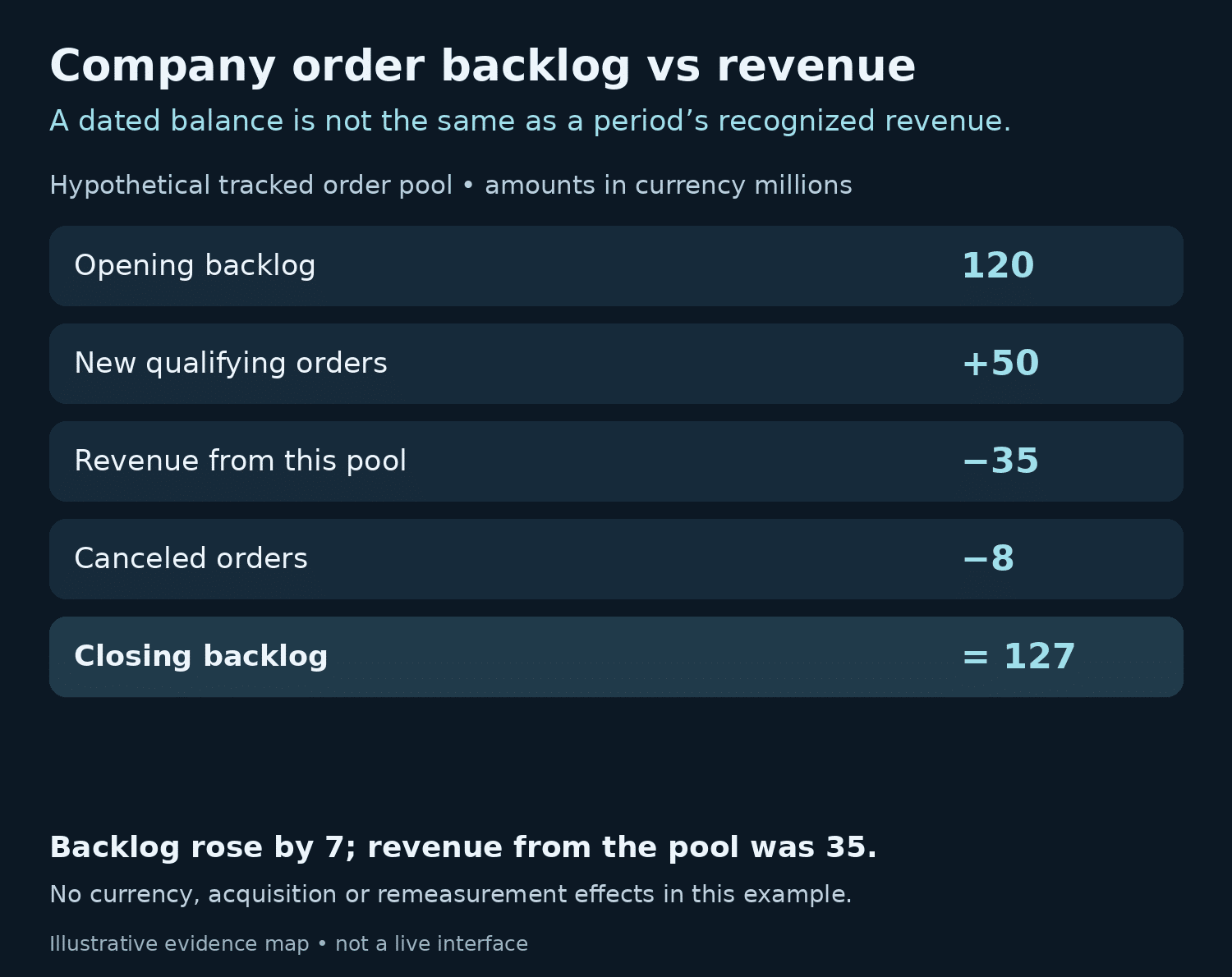
Assume Demo Equipment reports backlog as the unrecognized contract value of qualifying, non-optional customer orders. All figures below are millions of the same currency. The reporting boundary is unchanged, and there are no acquisition, currency or price-remeasurement effects in this first example.
- Opening backlog: 120.
- New qualifying orders added during the quarter: +50.
- Revenue recognized from orders included in this backlog: −35.
- Orders canceled before recognition: −8.
- Closing backlog: 120 + 50 − 35 − 8 = 127.
The closing backlog increased by 7, or approximately 5.83% of the opening 120. Revenue recognized from this pool was 35, not 7. The increase describes the net change in work remaining after several different flows.
Now add 5 of same-quarter business that is booked and completed without appearing in either quarter-end backlog. Total quarterly revenue becomes 40. If the company includes those short-cycle orders and their fulfillment in its backlog roll-forward, both additions and removals must increase by 5. The closing balance remains 127 either way.
That last distinction is a reconciliation check, not permission to mix conventions. The 50 additions and 35 removals above deliberately cover the tracked pool. A published total-orders measure may have a broader scope. Write the scope next to each number before trying to solve for a missing figure.
Explain a backlog decline before calling it weaker demand
Consider a second fictional quarter opening at 127. New qualifying orders add 30, revenue from the tracked pool removes 45, and cancellations remove 2. Closing backlog is 110. It fell by 17 even though the company recognized more revenue from the pool than in the first quarter.
The immediate explanation is that fulfillment and cancellations exceeded additions. Whether the smaller balance is desirable cannot be decided from subtraction alone. It could reflect faster completion, fewer incoming orders, a changing business mix or several effects together. Delivery schedules and management’s definitions provide context.
A larger backlog can also coexist with delays. If orders accumulate while completion slows, the balance rises without establishing stronger execution. Separate the amount of remaining work from the company’s capacity to perform it on the stated terms.
Do not turn a coverage ratio into a delivery forecast
Using the first quarter’s closing backlog of 127 and total revenue of 40 gives 127 ÷ 40 = 3.175 quarters. This is a scale comparison under the stated inputs. It is not a prediction that all orders will become revenue in exactly 3.175 quarters.
The numerator may contain multi-year work, while the denominator includes short-cycle business outside the tracked pool. Future completion rates, cancellations and new business need not resemble the quarter just observed. Annualizing the 40 to 160 produces 0.79375 years of coverage, but multiplying by four does not repair those conceptual differences.
A better evidence record separates scheduled near-term conversion from later work and labels any management estimate as an estimate. Keep the publication date. A historical delivery schedule should not silently become a current promise after conditions change.
Separate remaining work, billing and profitability
A backlog amount is not automatically a balance-sheet asset or a bank balance. A customer may have paid a deposit, may owe an amount under an unconditional billing right, or may not yet owe payment. The separate deferred revenue versus accounts receivable guide owns those accounting distinctions.
Likewise, 127 of remaining contract value is not 127 of future profit. Completing work requires costs. A project can produce revenue and still have an unfavorable margin. This article deliberately makes no margin assumption, so its ledger cannot support an earnings estimate.
When comparing companies, put definition, reporting date, currency, business coverage, recognition policy and material exclusions in one note. Then record new orders, fulfillment, cancellations and any disclosed remeasurement separately. The market research journal guide provides a place to retain sources and unresolved questions.
A defensible summary of the first example is: “Backlog rose from 120 to 127 after 50 of additions, 35 of recognized revenue from the tracked pool and 8 of cancellations. Total revenue was 40 including 5 of short-cycle business.” It explains the balance without claiming that every remaining order will be delivered.
A flat backlog can hide a change in the business boundary
Extend the reading exercise to a fictional group that acquires another business during the quarter. Its opening backlog is 200 million currency units. Existing operations add 45 of qualifying orders, remove 60 through performance and remove 5 through cancellations. A newly acquired business brings 12 of qualifying backlog into the group. Translation into the reporting currency adds a further 8. Assume those are the only movements.
The reported closing balance is 200 + 45 − 60 − 5 + 12 + 8 = 200. A headline saying “backlog unchanged” is arithmetically correct. A headline saying “demand unchanged” is not established. Before the acquisition and translation effects, the stated movements in the existing pool produce 180, a decline of 20. That decline still combines incoming orders, performance and cancellations; it is not a pure demand measure either.
Keep the 12 and 8 in separate rows. The acquired backlog is not a new customer order placed with the existing business during the quarter. The translation adjustment changes the reporting-currency measurement under this fictional example, not the number of underlying contracts. Removing both effects creates a clearly labelled analytical comparison, not a replacement for the reported balance or a universally defined “organic” metric.
If the company supplies only opening and closing totals, this bridge cannot be reverse-engineered reliably. There are many combinations of additions, removals and measurement changes that could produce the same endpoint. The correct note is “reported balance unchanged; components not disclosed,” not a guessed estimate of orders. An unexplained residual should remain a residual until the issuer provides a definition or reconciliation.
Follow a dated delivery cohort instead of subtracting two schedules
Another useful distinction is between a schedule for a particular pool and a rolling forecast containing new business. Suppose a fictional year-end backlog is 100. Management estimates that 60 of that pool will become revenue during the next year, with 40 later. At the next reporting date, it says that 55 is expected during the following twelve months. The difference between 60 and 55 is not automatically five of completed work.
The second schedule may include orders received since year-end, exclude cancellations, shift delayed work or cover a different twelve-month window. To assess the first estimate, you would need to identify the original pool and its subsequent outcomes. Ask how much of that specific cohort was recognized, canceled, rescheduled or still outstanding. Do not mix a fixed cohort with a moving forward-looking window.
This is especially important when reporting language changes from “scheduled deliveries” to “expected revenue.” The IFRS 15 overview links recognition to fulfilling performance obligations, not simply to an order announcement. A physical delivery schedule and an accounting recognition estimate need not describe the same event for every contract.
Make a comparison sheet before ranking two order books
Take two invented companies, each reporting 500 of backlog. Company A includes only qualifying signed work; Company B’s total includes a separately identified category awaiting funding. The equal totals cannot support a claim of equal certainty. The relevant comparison begins with the defined categories, not a ratio calculated from the headline numbers.
Boeing’s 2025 Form 10-K backlog section illustrates why reading the subcategories matters: contractual and unobligated amounts are separately disclosed. That is evidence about this issuer’s presentation, not a template that every business must follow. Preserve another issuer’s own language and identify genuinely comparable components.
A compact comparison sheet should name the filing date, included business units, contract qualification rules, optional or conditional amounts, currency basis and expected recognition pattern. Add a final field labelled “comparison not supported” when the definitions do not align. Explaining why two totals cannot yet be ranked is more useful than presenting a precise ratio whose inputs measure different things.
Keep the original reported total beside any comparable subtotal. Label every exclusion and its source so a later reader can reconstruct the adjustment without mistaking your analytical measure for a figure published by the company.
Frequently asked questions
Is company backlog the same as a stock-market order book?
No. Company backlog concerns customer contracts or orders under an issuer’s definition. A trading order book contains buy and sell interest for a security or other traded instrument.
Is a larger backlog always good news?
No. A larger balance can reflect incoming orders, slower fulfillment or changed measurement. Read the additions and removals together before assigning a cause or drawing conclusions about execution.
Can revenue rise while backlog falls?
Yes. In the second example, 45 of recognition plus 2 of cancellations exceeds 30 of additions. The balance falls to 110 while recognized revenue from the tracked pool increases.
Can I calculate revenue from the change in backlog?
Not from the change alone. You also need matching additions, cancellations and adjustments, and must know whether all revenue passes through the reported backlog measure.
Are orders announced in a press release automatically backlog?
Not necessarily. Qualification can depend on signed terms, approvals, options and the issuer’s inclusion policy. Match the announcement to the reporting definition instead of adding every headline value.
Is backlog identical to remaining performance obligations?
Do not assume equivalence. Compare the issuer’s definition, applicable accounting disclosures and exclusions. Similar labels can use different boundaries; the specific reconciliation matters more than the name.
Does backlog tell me how much cash customers have paid?
No. Remaining work and payment timing are different dimensions. Deposits, progress payments and final settlement depend on contract terms and belong in a separate cash or contract-balance analysis.
How should currency changes be handled?
If foreign-currency orders are translated into the reporting currency, a reported balance can move without equivalent new orders. Use disclosed currency effects when available and do not label an unexplained residual as demand.
Does backlog divided by annual revenue show guaranteed years of sales?
No. It is only a ratio of differently timed measures. Contract schedules, recognition patterns, cancellations and the scope of the revenue denominator can all prevent that interpretation.
What if the company does not publish a full roll-forward?
Retain the disclosed figures and identify the missing components. You can describe the change, but should not invent cancellations, new orders or conversion rates to force a complete reconciliation.
Explore CrowdSent and its current membership information. This article explains how to read financial information; it does not claim that CrowdSent audits company disclosures or processes corporate actions.
General education, not investment, accounting or tax advice. No price forecasts or recommendations are provided.