

Deferred revenue vs accounts receivable becomes clearer when three events are tracked separately: the customer is billed, the company performs its promise and cash changes hands. Those events can occur on different dates. Their order helps explain why a revenue figure, a bank receipt and a balance-sheet amount differ.
Deferred revenue commonly describes a contract liability associated with goods or services still owed to customers. Accounts receivable represents an unconditional right to consideration. This guide uses simplified IFRS-based examples; actual contract terms and the applicable reporting framework determine the accounting.
Deferred Revenue vs Accounts Receivable: begin with the promised service
The IFRS Foundation’s IFRS 15 overview explains that revenue follows satisfaction of performance obligations through transferring promised goods or services. A transfer can occur at a point in time or over time. Sending an invoice or collecting a deposit does not, by itself, determine when all the revenue is earned.
Assume Demo Support agrees to provide a customer with a uniform stand-ready support service for twelve months at a fixed $12,000 price. For this example, the service qualifies for recognition over time and an equal monthly pattern faithfully depicts performance. Taxes, refunds, financing effects and additional deliverables are omitted.
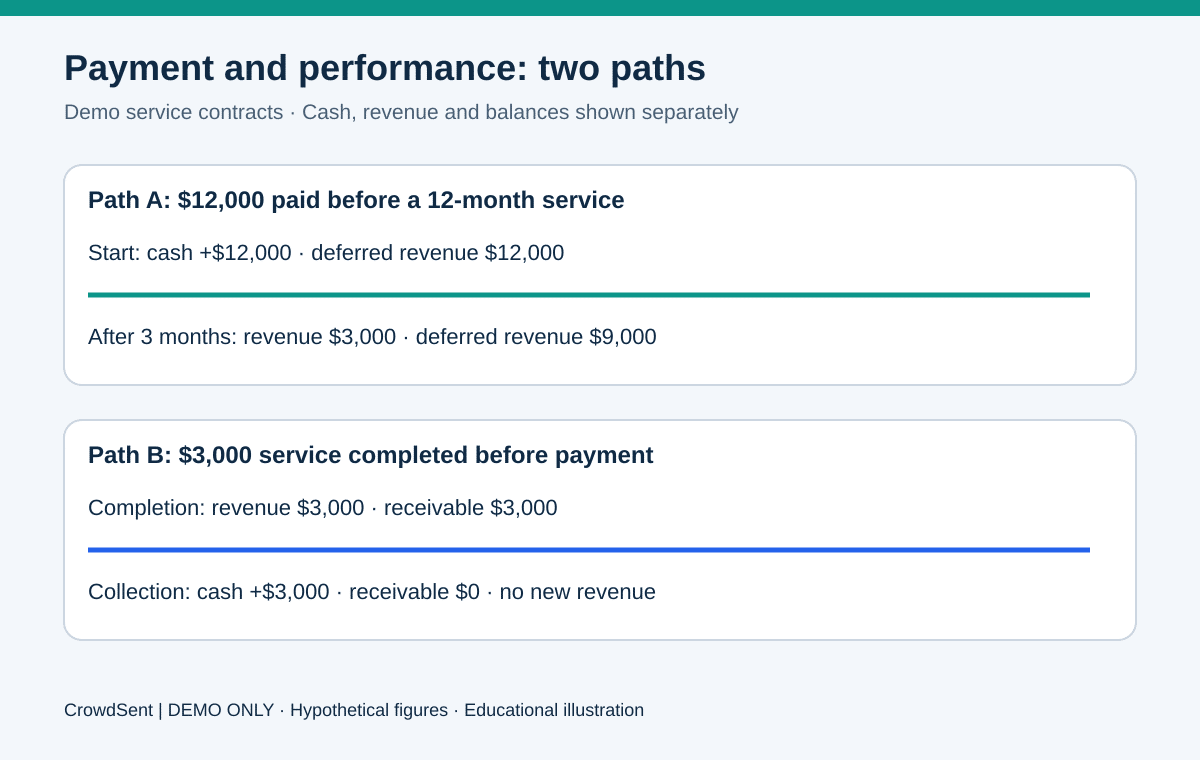
Follow the advance-payment path
The customer pays $12,000 immediately before service begins. Cash increases by $12,000, and the company records a $12,000 contract liability, described here as deferred revenue. At that moment, it has received money but still owes the full service.
After three completed months, the stipulated monthly revenue is $12,000 ÷ 12 = $1,000. Cumulative revenue is $3,000. Deferred revenue falls to $9,000 because nine months of the original promise remain. No additional cash arrives merely because the company recognizes that $3,000 of revenue.
At month six, cumulative revenue reaches $6,000 and the remaining liability is $6,000. After all twelve months of the promised service, cumulative revenue totals $12,000 and the liability reaches zero. These balances describe this one isolated contract, with no renewals or modifications.
Follow the credit-sale path
Now consider a separate, one-month support engagement priced at $3,000. Demo Support completes the service and has an unconditional right to the amount, with the customer paying 30 days later. At completion, it recognizes $3,000 of revenue and a $3,000 receivable.
When the customer pays, cash increases by $3,000 and the receivable decreases by $3,000. The payment does not create another $3,000 of revenue. Adding recognized revenue and collection as though they were two sales would count the same engagement twice.
ACCA’s trade-receivables explanation provides the credit-sale background. A receivable also needs an assessment of recoverability; an amount invoiced is not an assurance of cash collection. The worked case assumes full payment so that the timing mechanics remain visible.
Allow for the important overlap
It is tempting to define deferred revenue simply as cash received and receivables simply as revenue earned. That shortcut misses an important case. Under IFRS 15 paragraphs 105–109, an unconditional amount due before performance can create both a receivable and a contract liability. The official standard text may require access to open in full.
For a hypothetical enforceable $12,000 invoice due before the year of service begins, assume the right to payment is unconditional. Before payment and performance, the company can have a $12,000 receivable and a $12,000 contract liability, with no revenue yet recognized. Payment removes the receivable; later performance releases the liability into revenue.
This is why the terms of the right matter more than the invoice’s label. A right conditional on additional performance is different from a right for which only time remains before payment is due. IFRS 15 distinguishes a contract asset from a receivable on that basis.
Reconcile movement rather than guessing from growth
Imagine a simplified deferred-revenue roll-forward beginning at $20,000. New qualifying advance payments add $15,000, and revenue recognized from those liabilities subtracts $12,000. The closing balance is $23,000. The $3,000 increase does not mean that revenue for the period was $3,000.
Actual reconciliations can include amounts becoming due before payment, refunds, currency changes, acquisitions and other adjustments. Read the company’s disclosures before equating a liability movement with cash receipts. Likewise, a growing receivable balance may reflect increased activity, different billing terms or slower collections.
For each material contract, a simple review record can retain the service promise, price allocation, performance dates, billing conditions and receipts. Those facts let a reader reconstruct which balance belongs at a reporting date. A label alone cannot establish whether the company has earned revenue, collected cash or completed its customer obligation.
Frequently asked questions
1. Is deferred revenue normally an asset?
In the customer-contract setting used here, it is a liability for performance still owed. The cash received is a separate asset and can subsequently be spent.
2. Does collecting a receivable increase revenue again?
No. In the completed-service example, collection replaces a $3,000 receivable with $3,000 of cash. Revenue was recognized when the service was performed.
3. Can a receivable exist before revenue?
Yes. An unconditional right to advance payment can be recognized alongside a contract liability before the related performance occurs. The enforceable contract terms are essential.
4. Is every unpaid invoice an ordinary receivable?
The accounting depends on the rights and conditions. An invoice label alone does not establish that the right is unconditional or resolve whether performance has occurred.
5. How is a contract asset different?
A contract asset concerns consideration for performance already transferred when the right remains conditional on something beyond time. A receivable has an unconditional right to consideration.
6. Does deferred revenue guarantee future profit?
No. The company must still incur whatever costs fulfillment requires, and contract changes or refunds may matter. A revenue-related liability is not a calculation of future margin.
7. Must subscription revenue always be spread evenly?
No. The recognition pattern follows the actual obligations and their satisfaction. Equal monthly amounts are an explicit assumption of this uniform-service demo, not a universal subscription rule.
8. Is deferred revenue the same as backlog?
Not necessarily. Backlog can include future orders or contractual amounts without a recognized contract liability. Use each company’s definition and avoid combining unlike operating measures.
9. What happens if a customer might not pay?
Receivables require the relevant impairment assessment. The recoverable amount and recognition requirements need review; expected collection problems should not be ignored because an invoice exists.
10. Which documents help resolve a confusing balance?
Read the contract, invoice terms, performance evidence and cash receipts together. For public financial statements, the revenue-recognition policy and contract-balance notes provide the best starting context.
Keep the source date, units, reporting boundary and calculations together in a market research journal so later comparisons can be reproduced.
Sources and further reading
- IFRS Foundation: IFRS 15 Revenue from Contracts with Customers
- IFRS 15, paragraphs 105–109
- ACCA: Trade receivables and revenue
Educational examples only. Figures are hypothetical and do not provide investment, tax or accounting advice.
Explore CrowdSent membership.