

Clean price vs dirty price is the distinction between a bond price excluding accrued coupon interest and a full price including it. For the ordinary coupon-bond example in this guide, dirty price equals clean price plus accrued interest. Converting that per-100 price into a currency amount requires a separate face-value calculation.
A quote of 99.25 therefore does not, by itself, tell you the cash amount for 10,000 of face value. The original ledger below keeps the clean component, accrued coupon and any separately disclosed charges visible. All figures and conventions are hypothetical.
Clean price vs dirty price needs a unit label
The Reserve Bank of India’s securities primer, section 22, explains the clean-price, accrued-interest and total-consideration relationship. The relevant price and interest must use the same face-value basis before they are added.
Begin the clean price vs dirty price worksheet with “99.25 currency units per 100 face,” rather than simply “99.25.” Record the holding separately as 10,000 currency units of face value. Dividing 10,000 by 100 gives a multiplier of 100 quotation units. This step prevents a per-100 quote from being mistaken for a cash total.
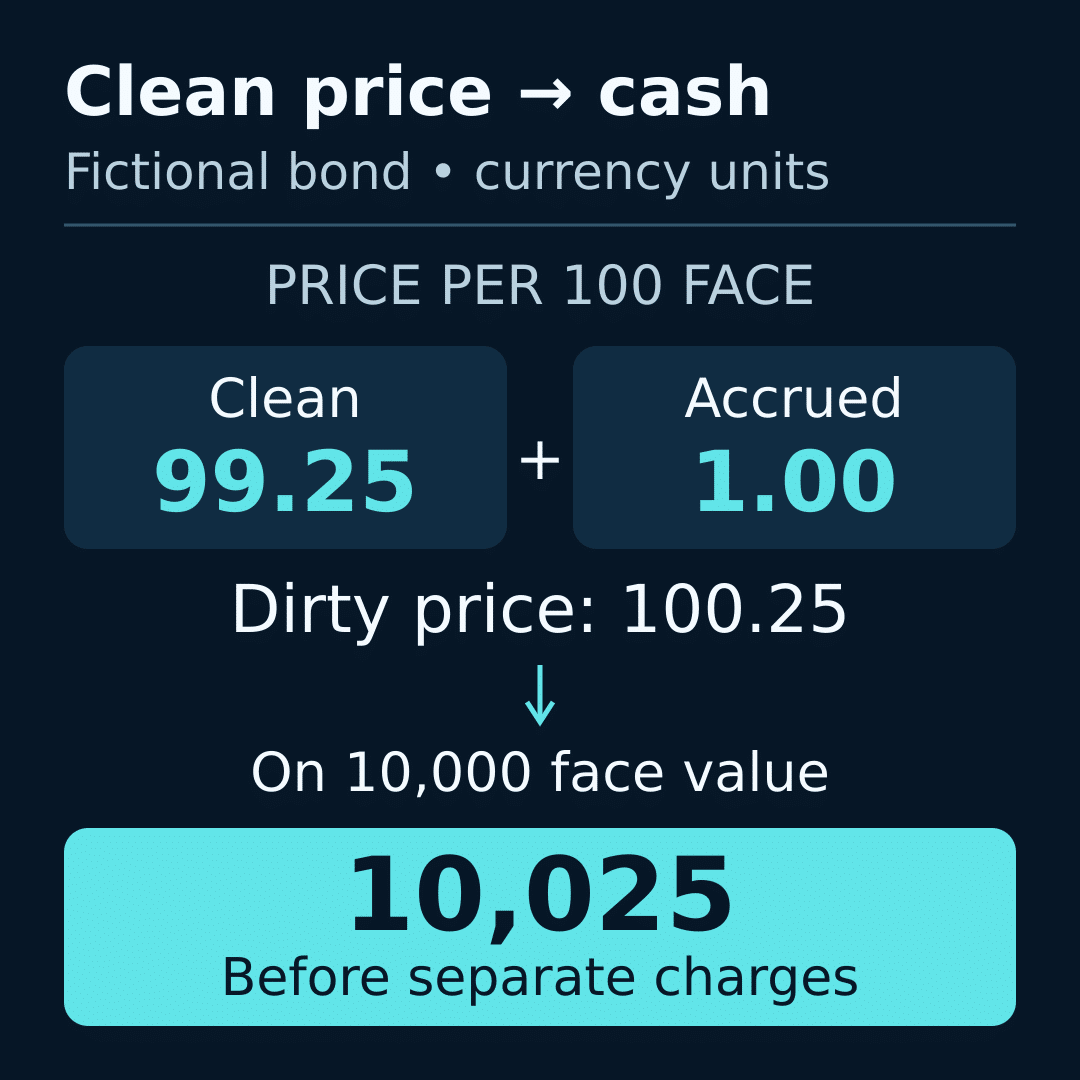
The clean component is consequently 99.25 × 100 = 9,925. That number is below the 10,000 face amount. It does not yet include the accrued coupon for the specified point in the coupon period.
Follow one coupon period through the calculation
Give the fictional bond a fixed annual coupon rate of 6%, paid in two equal regular installments. Each installment is 3 per 100 face, or 300 for the 10,000 face holding. The annual 600 coupon amount and the individual 300 payment are different fields.
Assume a stated 30/360 convention and exactly 60 accrued days within a normal 180-day coupon period. These are supplied inputs, not calendar dates from which the reader must guess a day-count variant. The example excludes ex-coupon adjustments, default and irregular periods.
Accrued interest per 100 face = 100 × 0.06 × 60/360 = 1.00. Check the same result using the periodic coupon: 3 × 60/180 = 1.00. The elapsed fraction is one-third of this fictional coupon period, so one-third of its 3.00 coupon has accrued.
The two calculations agree because their rate and time bases match. Applying the full annual 6 to 60/180 would give 2.00 and double-count the frequency. Applying the semiannual 3 to 60/360 would give 0.50 and halve the intended accrual.
FINRA’s bond overview explains accrued interest as an amount generally transferred to compensate the seller for the relevant part of the coupon period. It is distinct from a brokerage charge and does not create a second issuer coupon.
Clean price vs dirty price: convert the quote to cash
Add the amounts on their common per-100 basis: 99.25 clean price plus 1.00 accrued interest gives 100.25 dirty price. Multiply by the 100 quotation units in the holding to obtain 10,025 before any separate charges.
On a narrow screen, scroll the table sideways to read every column.
| Component | Per 100 face | Currency amount |
|---|---|---|
| Clean component | 99.25 | 9,925 |
| Accrued coupon | 1.00 | 100 |
| Dirty/full component | 100.25 | 10,025 |
The clean price vs dirty price calculation explains this result: the clean quote is below 100, while the full amount exceeds face value. Both statements follow from the same ledger. Comparing 10,025 directly with the clean-price-only 9,925 would identify a 100 difference that the accrued-interest line already explains.
Use a scaling check before investigating a complex discrepancy. For 5,000 face under the identical assumptions, the multiplier is 50, the clean component is 4,962.50, accrued interest is 50, and the full amount is 5,012.50. Every amount halves, while the quoted prices stay unchanged.
If a separate fictional charge of 7.50 is then specified for the 10,000-face transaction, list it below the full component. The resulting total is 10,032.50. Dirty price remains 100.25 per 100 face; adding the charge to the cash total does not redefine accrued interest.
Read a coupon-date reset with its matching payment
Now isolate the coupon-payment event in a theoretical before-and-after ledger. Hold clean price fixed at 99.25 solely for this exercise. Assume the holder receives the full 3.00 coupon per 100 face, with no ex-coupon complication or other price movement.
Immediately before the modeled payment, full price is 99.25 + 3.00 = 102.25. Immediately afterward, accrued interest resets to zero, giving a full price of 99.25. The same holder also has 3.00 of coupon cash, so 99.25 + 3.00 reconciles to the earlier 102.25.
For 10,000 face, that comparison is 10,225 before versus 9,925 of remaining bond value plus 300 cash afterward. Looking only at the full-price series would omit the payment. Counting the 300 in both accrued interest and cash after payment would count it twice.
This clean price vs dirty price reconciliation holds the inputs fixed to isolate the coupon payment. It does not assert that actual market prices hold steady across a payment event, nor does it establish a complete holding-period return. Its purpose is to make one cash movement visible.
Reconcile clean price vs dirty price in a settlement record
First confirm the security identifier, face amount and whether the quote is clean or full. Then check the applicable settlement date, coupon schedule, day-count definition and entitlement terms. A saved trade timestamp alone does not identify all the accrual inputs.
Next compare precision. A displayed accrued value rounded per 100 can produce a different currency total from a system that scales the unrounded value first. Keep the source precision and rounding rule when available. Do not fix an unexplained difference by changing the formula’s output manually.
Use the source-verification checklist to locate the instrument’s actual terms. Unusual coupon periods, changing principal or special coupon-entitlement rules need their own method. Keep the checked records in a market research journal so the cash reconciliation remains reproducible.
Frequently asked questions
Why can the cash amount exceed a below-par clean quote?
Accrued coupon is added on the same price basis. Our 99.25 clean quote becomes 100.25 after adding 1.00 of accrued interest. For 10,000 face, the resulting 10,025 full component can therefore exceed face even though the clean component does not.
Does “dirty price” mean a quote is incorrect?
The term names the full-price convention used here. It does not judge data quality. A record can show a perfectly consistent clean price and dirty price; the check is whether their difference matches the applicable accrued interest.
Is coupon accrual calculated on face value or purchase price?
Our specified fixed coupon uses face value. The 6% annual rate applies to 10,000, producing 600 annually and 100 for the supplied accrued fraction. Substituting the 9,925 clean consideration would change the stated coupon basis.
Why is the next coupon 300 when the annual coupon is 600?
The example splits the annual amount into two equal regular payments. One installment is 300; the supplied accrual covers one-third of that installment’s period. Keep annual rate, payment frequency and elapsed fraction in separate fields.
Does 30/360 apply to every bond?
No universal convention is assumed here. The example supplies 30/360 and an already-established 60-day accrued count to make its arithmetic reproducible. For an actual instrument, obtain the exact convention and schedule rather than copying those fictional inputs.
Which date should an accrued-interest worksheet use?
Use the relevant settlement-date and entitlement conventions for the instrument and record being reconciled. Our example avoids a calendar shortcut by supplying the accrued count directly. Replacing it with a count to the screen-capture date could answer a different question.
Is accrued interest a fee paid to the broker?
The accrued coupon and a separate charge are different ledger items. In our extended example they are 100 and 7.50 respectively. Their destinations and explanations should remain separately documented rather than combining both under a generic “fees” heading.
Does a coupon reset by itself show an investment loss?
The isolated reset must be read with its matching cash payment. Our holder moves from a 102.25 full-value reference to 99.25 plus 3.00 cash. An actual return calculation would also need its starting value, other cash flows and applicable costs.
Are clean and dirty price always equal without a regular coupon?
Check the instrument’s pricing definition. Our equality after payment follows from an explicitly zero accrued-coupon line. A different instrument’s terminology, accrual or principal adjustment should not be inferred solely from the absence of this example’s semiannual schedule.
What commonly explains a small reconciliation difference?
Compare the full input trail: price basis, face quantity, accrual date, day count, precision and separate charges. Also confirm you used the intended quote side. A small difference deserves an explanation, not an automatic assumption that either record is wrong.
Educational explanation by the CrowdSent Blog Team. Sources checked 13 October 2026. All examples are hypothetical and are not investment recommendations.