

CrowdSent Blog Team · Blockchain literacy
Bitcoin confirmations describe how deeply a transaction is included in the accepted blockchain. The block containing it gives the first confirmation. Each subsequent block extending that chain adds another. This makes a confirmation count a measure of block depth, rather than a stopwatch or a receipt from an exchange.
A screen showing “three confirmations” can be accurate while another service still shows “processing.” Understanding the difference requires three separate records: the transaction’s inclusion, the current chain tip and the service’s own processing stage. This guide follows those records through one invented example.
For the broader network introduction, see what Bitcoin is and how its participants fit together. Here the question is narrower: what exactly does a changing confirmation count establish?
How Bitcoin confirmations count block depth
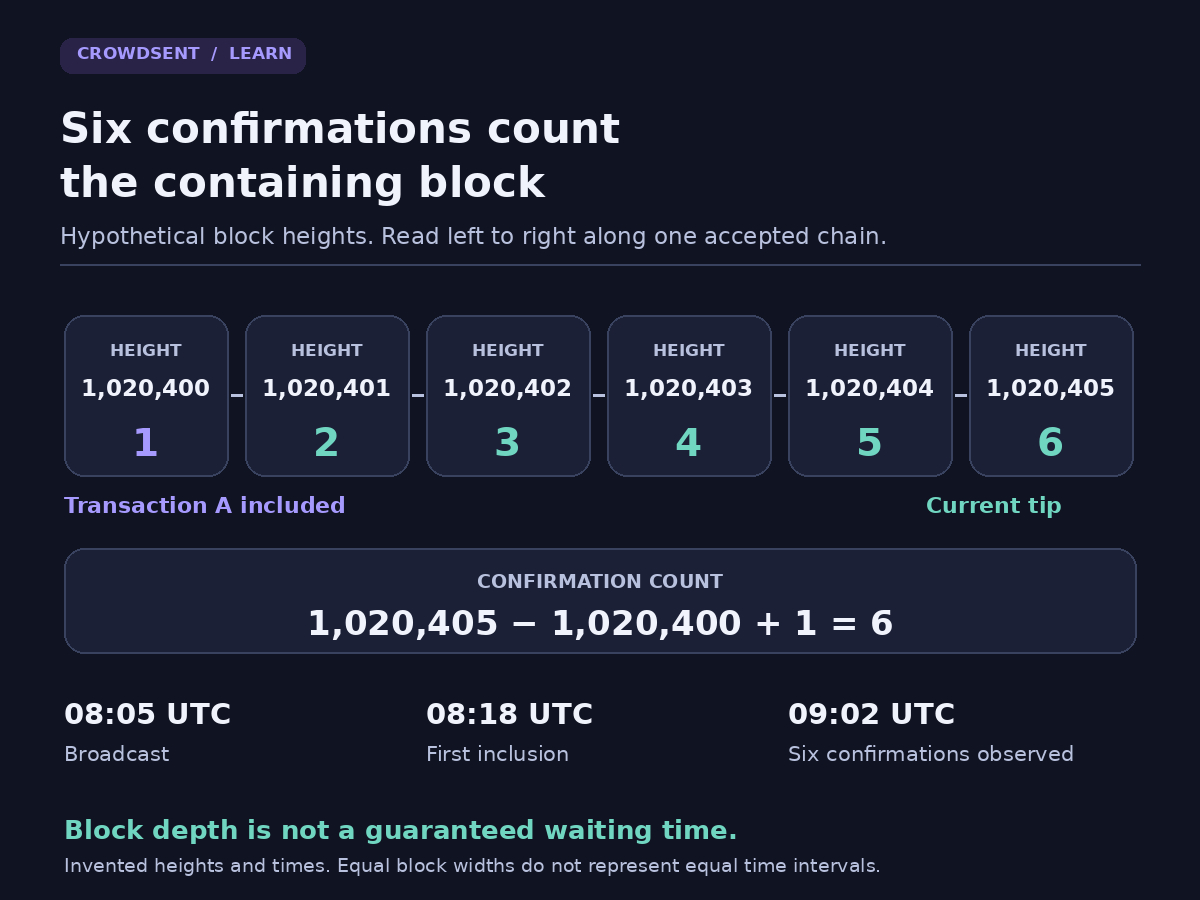
When a transaction remains on the active chain, its confirmation count is the current tip height minus its inclusion height, plus one. The extra one counts the containing block itself. A transaction included in the latest block therefore has one confirmation, even though no later block has yet appeared.
Use invented heights to keep the arithmetic separate from current network conditions. Suppose Transaction A enters the accepted chain at height 1,020,400. When the tip is also 1,020,400, the count is 1. At tip 1,020,401 it is 2. At tip 1,020,405 it is 6: 1,020,405 − 1,020,400 + 1 = 6.
These heights are teaching labels, not a claim that a real transaction appeared in those blocks. The calculation also assumes the transaction’s containing block remains in the active chain. If a source reports a different branch or an older tip, subtracting the numbers without checking that assumption can mislead.
The Bitcoin Core transaction reference documents confirmations alongside block identity and conflict information. Recording the block hash as well as its height helps distinguish competing blocks at the same height.
Separate broadcasting, mempool visibility and inclusion
An unconfirmed transaction has not yet acquired a confirmation in the accepted chain. A wallet may have created and broadcast it, and some nodes may hold it in their mempools, which are their local collections of transactions awaiting inclusion. Those observations describe progress, but none is identical to block inclusion.
Different nodes need not show exactly the same pending collection at every instant. Their information can arrive at different times, and their policies can differ. A transaction absent from one explorer’s pending view has therefore not automatically been proven nonexistent, invalid or permanently lost.
Treat the transaction identifier as the beginning of an investigation. Check the named network, whether the record has a containing block, and the source’s latest observation. “Submitted,” “seen,” “pending” and “confirmed” are useful labels only when the interface explains what each represents.
For an invented research log, record “seen by Source A at 08:05 UTC, no containing block shown” before recording any later inclusion. That preserves what was actually known at the earlier time. Replacing the original entry with the later count would erase the distinction you are trying to understand.
Read confirmation time as uncertain
Bitcoin aims for an average block interval of roughly ten minutes. Individual gaps vary because finding a valid proof of work is probabilistic. The Bitcoin project’s user guidance explicitly warns that a confirmation can arrive much sooner or later and that the first inclusion can take longer when a transaction is not being prioritised.
Imagine Transaction A is broadcast at 08:05 UTC, included at 08:18 and followed by five further blocks by 09:02. The first wait is 13 minutes. The total from broadcast to six confirmations is 57 minutes. Neither interval becomes a schedule for Transaction B. All times here are deliberately invented.
A second transaction could be included in the same block after being broadcast at 08:17. It would reach the same confirmation count at the same chain tip while having spent one minute waiting for first inclusion. Confirmation depth alone cannot reveal how long either sender waited before inclusion.
For readers sharing notes across India and Pakistan, preserve a common UTC timestamp. A display can add local time, but the count comes from the chain, not the reader’s location. Do not infer a local payment-processing promise from a network’s average interval.
Understand what a reorganisation changes
Nodes can temporarily encounter competing valid branches. Bitcoin’s chain-selection rules prefer the valid chain with the most accumulated proof of work. If the preferred history changes, a block previously shown as active can leave that history. This is a chain reorganisation, often shortened to reorg.
The Bitcoin white paper explains why extending the proof-of-work history makes replacement harder under its security assumptions. That supports a probabilistic description of settlement. A fixed confirmation count does not make reversal logically impossible in every scenario.
Continue the invented example. At tip 1,020,402, Transaction A originally has three confirmations. Suppose a replacement branch excludes its old block but includes A at height 1,020,401. Its new count at that same tip is two. The transaction identifier can stay the same while its inclusion block and depth change.
If the replacement branch does not include A, the current record needs further inspection. A may return to a pending state if still valid, or conflict with another transaction. Simply subtracting one confirmation from the old screenshot is insufficient. Recheck the active block and the transaction’s current status.
This also explains why a saved screenshot should carry an observation time. It documents what the source reported then. It cannot promise what that source will report after a reorganisation or after it catches up with newer blocks.
Compare two source snapshots
Compare two sources for the same ordinary transaction on the same Bitcoin network. The times, heights and hash labels below are invented.
- Source A, observed at 09:02:10 UTC: inclusion height 1,020,400, hash Block-P; tip height 1,020,405, hash Tip-R. Count: 1,020,405 − 1,020,400 + 1 = 6.
- Source B, observed at 09:02:12 UTC: inclusion height 1,020,400, hash Block-P; tip height 1,020,404, hash Tip-Q. Count: 1,020,404 − 1,020,400 + 1 = 5.
The sources agree on inclusion and differ by one tip block. This is consistent with a refresh lag if Tip-Q is the parent of Tip-R. Check that ancestry and each source’s update state; the counts and observation times alone do not establish the cause.
Now consider a separate comparison at 09:03:00 UTC. Both sources report tip 1,020,405 with hash Tip-R. A still reports inclusion in Block-P at 1,020,400, giving six confirmations. B instead reports inclusion in Block-S at 1,020,401, giving 1,020,405 − 1,020,401 + 1 = five.
The reported tips now match, but the containing-block claims disagree. A one-block difference in reported tip height cannot explain this count gap. Recheck the transaction identity, containing blocks, ancestry and source freshness. Do not infer a reorganisation or average the counts from these conflicting fields alone.
The bounded conclusion is that the first pair may reflect different tip snapshots, while the second needs inclusion-record reconciliation. Neither comparison establishes a guaranteed waiting time or a service’s acceptance threshold.
Keep a service’s threshold separate from chain depth
A custodial service may wait for a stated number of confirmations before crediting a deposit. It can also have its own screening, maintenance or account-processing stages. The network’s inclusion record and the service’s decision to update its internal balance are separate pieces of evidence.
Suppose a fictional service states that it begins processing after four confirmations. Transaction A has five, but the account page still says pending. The observed gap supports a specific question about that service’s processing. It does not by itself prove that Bitcoin has stopped confirming transactions.
A threshold describes that service’s policy, which should be checked in its current official documentation. Avoid treating a number copied from another platform as a universal network requirement. This article provides no recommended acceptance threshold for a payment or deposit.
When reporting a delay, separate “chain count observed at time X” from “account credit observed at time Y.” If the service gives no timeline for the second stage, retain that uncertainty rather than adding the average block interval until a guessed deadline appears.
Build a transaction-status record you can verify
A compact evidence record needs the network, transaction identifier, containing block hash and height, current tip, confirmation count, retrieval time and source. Keep any service status in a separate field. The record can be prepared from public information without disclosing recovery material or approving any transaction.
- Identify the claim precisely: pending inclusion, a particular depth, or account credit.
- Confirm that the source covers Bitcoin’s intended network, rather than a test network or another asset.
- Record the inclusion block and chain tip together before calculating depth.
- Check replacement or conflict information if the expected transaction is missing.
- Revisit the original claim using the status and time actually observed.
The Bitcoin payment-processing guide describes transaction verification and confirmation-related concerns. Its technical context helps explain why an identifier alone is incomplete evidence of settled payment.
For a report that began with a screenshot or social post, use the market-news verification checklist to preserve the original claim. Keep the resulting record in a market research journal so a later status change can be documented rather than silently overwritten.
A useful conclusion is bounded: “At 09:02 UTC, the observed active tip gives Transaction A six confirmations.” That sentence establishes depth at an observation time. It leaves the recipient’s identity, the economic purpose of the payment and any separate account-crediting outcome to their own evidence.
Frequently asked questions
1. What does one Bitcoin confirmation mean?
It means the transaction is included in a block on the accepted chain, as seen by the source being checked. The containing block counts as the first confirmation. Always attach the observation time, because the active chain and a source’s latest information can change.
2. Does six confirmations mean six blocks came after the transaction?
The containing block supplies one confirmation, so five subsequent blocks produce a total of six. In the example, inclusion at 1,020,400 and a tip of 1,020,405 give six. Omitting the plus one creates a common counting error.
3. Can an hour pass with no first confirmation?
Yes. The average block interval does not guarantee that a particular pending transaction will be included in the next block. Inclusion depends on more than elapsed time. Read the actual transaction record instead of calculating a guaranteed completion time from the clock.
4. Can confirmations decrease?
They can change after a chain reorganisation or when an interface corrects an outdated view. Inspect the current containing block, active tip and any conflict information. A falling displayed number needs an explanation, but it does not by itself identify the cause.
5. Why do two explorers show different counts?
They may be observing different tips, refreshing at different times or temporarily showing different chain information. Compare block hashes, heights and retrieval times. A difference of one can reflect a newly received block, but verify rather than assuming every discrepancy is harmless.
6. Does a transaction ID prove a deposit has been credited?
An identifier locates a transaction record. Deposit credit belongs to a service’s internal account process. Establish network inclusion and any required policy threshold, then check the account record separately. An on-chain record alone cannot certify that internal step.
7. Is zero confirmations the same as a failed transaction?
Zero describes lack of confirmed depth. Depending on the source, the transaction may be pending, replaced, missing from its current mempool or otherwise unresolved. Read the accompanying status and conflict fields before giving the zero a more specific meaning.
8. Does a higher fee buy additional confirmations?
A transaction fee concerns inclusion incentives. After inclusion, depth increases as later blocks extend the containing chain; the fee does not purchase extra depth inside one block. Do not interpret a fee difference as a promise of a particular confirmation count at a fixed time.
9. Do Bitcoin and Ethereum confirmation counts mean identical settlement?
Their consensus and finality rules differ. A comparable-looking number does not make their security interpretation interchangeable. State the named network and what its interface measures. Bitcoin block depth should not be substituted for Ethereum’s separate finality concepts.
10. What information is safe to use for this learning exercise?
Use public documentation and the invented block heights here. No private key, recovery phrase, wallet connection or signature is required. If working with public identifiers from another context, avoid publishing unnecessary links between those identifiers and a person’s identity.
Prepared 9 October 2026. Examples are invented for education and contain no real wallet identifiers. This article explains evidence and terminology; it does not provide investment recommendations.