

Working capital vs cash is a comparison between a net measure and an asset balance. A company can report positive working capital and still struggle to make a payment on time. Understanding the difference starts with the components behind the total, especially receivables, inventory and bills due soon.
This guide uses net working capital, calculated as current assets minus current liabilities. It treats cash as a separately identified current asset and uses hypothetical dollars throughout. The aim is to explain a balance sheet, rather than assign a universal safe level of cash.
Working Capital vs Cash: identify what each number includes
The SEC’s financial-statement guide explains working capital as the difference between current assets and current liabilities. Cash is included among assets, but so are amounts customers owe and goods awaiting sale. Subtracting liabilities does not turn those other assets into immediately spendable money.
Cash and cash equivalents also deserve separate attention. The IFRS Foundation’s IAS 7 overview describes cash equivalents as highly liquid, short-term investments convertible to known cash amounts with insignificant value risk. An ordinary investment holding does not qualify merely because it can be sold.
Use the actual statement’s classifications. Current generally concerns the operating cycle or a near-term reporting horizon; it does not mean every amount settles tomorrow. Also read disclosures about restrictions before treating a reported balance as available for any payment.
Build a hypothetical working capital calculation
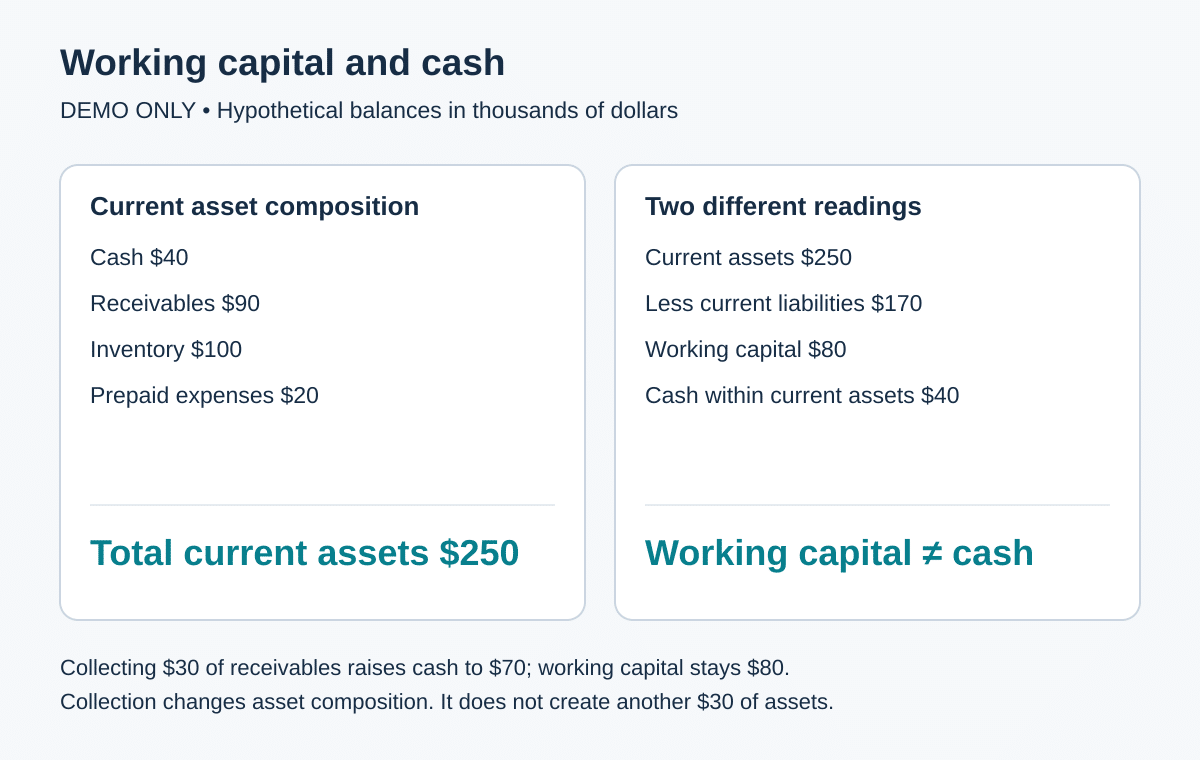
Imagine ExampleCo reports $40,000 cash, $90,000 receivables, $100,000 inventory and $20,000 prepaid expenses. Current assets total $250,000. Its current liabilities are $170,000, including supplier balances, accrued expenses and debt due within the current classification.
Net working capital is $250,000 minus $170,000, or $80,000. Cash remains $40,000. Calling the full $80,000 a cash reserve would overlook the composition of the assets and the obligations already deducted in that calculation.
Suppose $55,000 of obligations must be settled this week, while the relevant customers will pay next month. The cash balance alone is $15,000 below that immediate requirement. Positive working capital does not resolve the timing mismatch. This simplified example assumes no other available cash receipts or funding.
Watch cash move while working capital holds steady
First, assume a customer pays $30,000 of an existing receivable. Cash rises from $40,000 to $70,000 and receivables fall from $90,000 to $60,000. Total current assets remain $250,000, so working capital remains $80,000. Counting the collection as additional revenue would also misread a sale already recognized.
In a separate scenario starting from the original balances, ExampleCo pays $20,000 of an existing supplier liability. Cash falls to $20,000, current assets fall to $230,000 and current liabilities fall to $150,000. Working capital is still $80,000. The payment settles an obligation while reducing the cash available for the next one.
Now consider buying $10,000 of inventory for cash, again from the original position. Cash falls to $30,000 and inventory rises to $110,000. With no other changes, current assets and working capital are unchanged. These examples show why a single net balance cannot describe the composition of liquidity.
Separate borrowing from operating progress
If ExampleCo instead borrows $50,000 through a current loan, cash and current liabilities both rise by $50,000. Working capital stays $80,000. The business has more cash on hand and a matching obligation, whose maturity and interest cost need attention.
If that borrowing were properly classified as noncurrent, the same initial cash receipt would raise working capital by $50,000 because the liability would sit outside the current subtotal. Neither version establishes that customers bought more or that operations became more profitable. Classification and funding explain the change.
These are isolated transactions. Real reporting periods contain many simultaneous movements, including accruals, write-downs and currency effects. Compare the opening and closing components and use the cash-flow statement to investigate the actual cash movement.
Read the operating cycle beside the total
A practical review asks when receivables are expected to arrive, how much inventory can realistically be sold, and when liabilities require settlement. Slow-moving inventory and overdue customer balances can make the current-asset total less useful for near-term payment planning.
A negative working-capital amount also needs context. A business collecting customer payments before paying suppliers may operate with a different funding pattern from a manufacturer carrying months of stock. Neither a positive nor negative figure, on its own, establishes financial resilience.
Keep reported net working capital distinct from an analyst’s operating working-capital measure, which may exclude cash and borrowing. Write down the chosen definition before comparing companies or periods. Otherwise a change in the formula may look like a change in the business.
Frequently asked questions
1. Is working capital a bank-account balance?
No. Net working capital combines several current assets and subtracts current liabilities. Only part of the asset total may be cash held in accounts.
2. Does collecting a receivable increase working capital?
Ordinarily it exchanges a receivable for cash at the same amount. In the worked example, total current assets and working capital remain unchanged.
3. Why does paying a supplier leave working capital unchanged?
Paying an existing current liability reduces cash and that liability equally. The example assumes the payment creates no new expense, discount or other adjustment.
4. Can a business have cash and negative working capital?
Yes. It can hold cash while total current liabilities exceed current assets. The exact payment timetable then becomes especially important.
5. Is cash flow the same as cash?
Cash is a balance at a date. Cash flow describes movement over a period. A company can generate cash during a year while ending with a modest cash balance.
6. Do prepaid expenses help pay tomorrow’s bills?
Usually they represent benefits already paid for, rather than cash that can be redirected. Their inclusion in current assets does not make them immediately spendable.
7. Does inventory growth always improve liquidity?
No. Inventory bought for cash changes the asset mix without increasing working capital. Unsold or obsolete stock may also require a write-down.
8. Should restricted cash be treated as freely available?
No. Check the restriction, financial-statement presentation and permitted uses. A reported cash-related asset may be unavailable for the particular obligation being assessed.
9. Can a longer-term loan raise working capital?
Yes, if it increases current cash while the corresponding liability is classified as noncurrent. That mathematical increase still comes with repayment and financing obligations.
10. What should accompany a saved working capital figure?
Record the reporting date, currency, current-asset and liability components, chosen definition, and relevant timing or restriction notes. These details make later comparisons reproducible.
Educational note: This article explains financial-statement analysis, not investment advice. All company figures are hypothetical. Ratios and cash-flow measures do not predict share prices or guarantee financial outcomes.
Explore CrowdSent membership.
Keep the source date, units, reporting boundary and calculations together in a market research journal so later comparisons can be reproduced.