

A rights issue raises equity capital by offering additional shares in proportion to eligible existing holdings. Understanding it requires following both the new shares and the subscription money. A lower subscription price, considered alone, does not establish a gain for the holder.
This guide follows a fictional one-for-four offer from the company’s capital change to one shareholder’s ownership percentage. All values are theoretical currency units (CU), with deliberately simplified terms. No example is an invitation to participate in an actual offer.
Read the rights issue ratio before the discount
The ratio states how many new shares are offered relative to existing eligible shares. One-for-four means one new share for every four old shares. A holder with 40 eligible shares would therefore have an entitlement to subscribe for ten new shares.
SEBI’s introductory rights-issue guide describes this proportionate capital-raising structure. The actual offer document supplies the ratio, subscription price and timetable. Use those terms rather than inferring the whole transaction from a headline discount.
Keep a four-field note: existing shares, offered new shares, subscription price per new share and whether that payment fully pays the share. This is enough to begin the simple arithmetic, but it is not a substitute for reading the offer’s conditions.
An entitlement is different from an allotted share
An entitlement records the opportunity to subscribe under the offer. An allotted share is the resulting security after the relevant process has been completed. They should occupy different rows in a research ledger.
For India’s NSE market, the exchange’s rights-entitlement FAQ states that purchasing a rights entitlement does not itself obtain the offered shares: an application is still needed, and unused entitlements can lapse. This process point should not be transferred to another market without checking its documentation.
Record the entitlement-trading window separately from the subscription or application deadline. A date attached to one stage may not govern another. If a report omits either field, mark it unverified instead of substituting a date from a previous offer.
Build the new share count and cash bridge
Fictional offer: a company has 1,000 equal-right shares with a pre-separation market-price reference of CU100 each. It offers 250 new equal-right shares at CU80. Assume all 250 are fully paid and allotted, with no fees, taxes, financing costs, timing effects or other news.
The initial market-value reference is 1,000 × CU100 = CU100,000. Subscription proceeds are 250 × CU80 = CU20,000. After the issue, there are 1,250 shares. The model’s combined value reference is CU120,000.
The share count rises by 25%, and the model adds CU20,000 of new capital. Those are different changes with different units. Writing “25% dilution” beside the issue without specifying whose ownership or which per-share measure is being discussed would hide that distinction.
Calculate a theoretical ex-right price
Theoretical ex-right price = (CU100,000 + CU20,000) ÷ 1,250 = CU96 per share. This spreads the old reference value and the additional cash across the expanded share count.
The historical PSX KSE-30 methodology brochure illustrates this type of ex-right arithmetic. It is a methodological reference here, not a source for current offer deadlines, trading procedures or index rules.
CU96 is a conditional model result. A quoted market price can differ because expectations, execution, financing, costs and offer terms are not frozen in real life. The calculation does not predict an opening price or guarantee that any entitlement can be sold.
For this exercise, define one entitlement unit as the right to subscribe for one new share. Its theoretical value is CU96 − CU80 = CU16. The CU20 gap between the old CU100 price and CU80 subscription price uses a different price basis; it is not the entitlement value in this model.
Follow the same holder through three outcomes
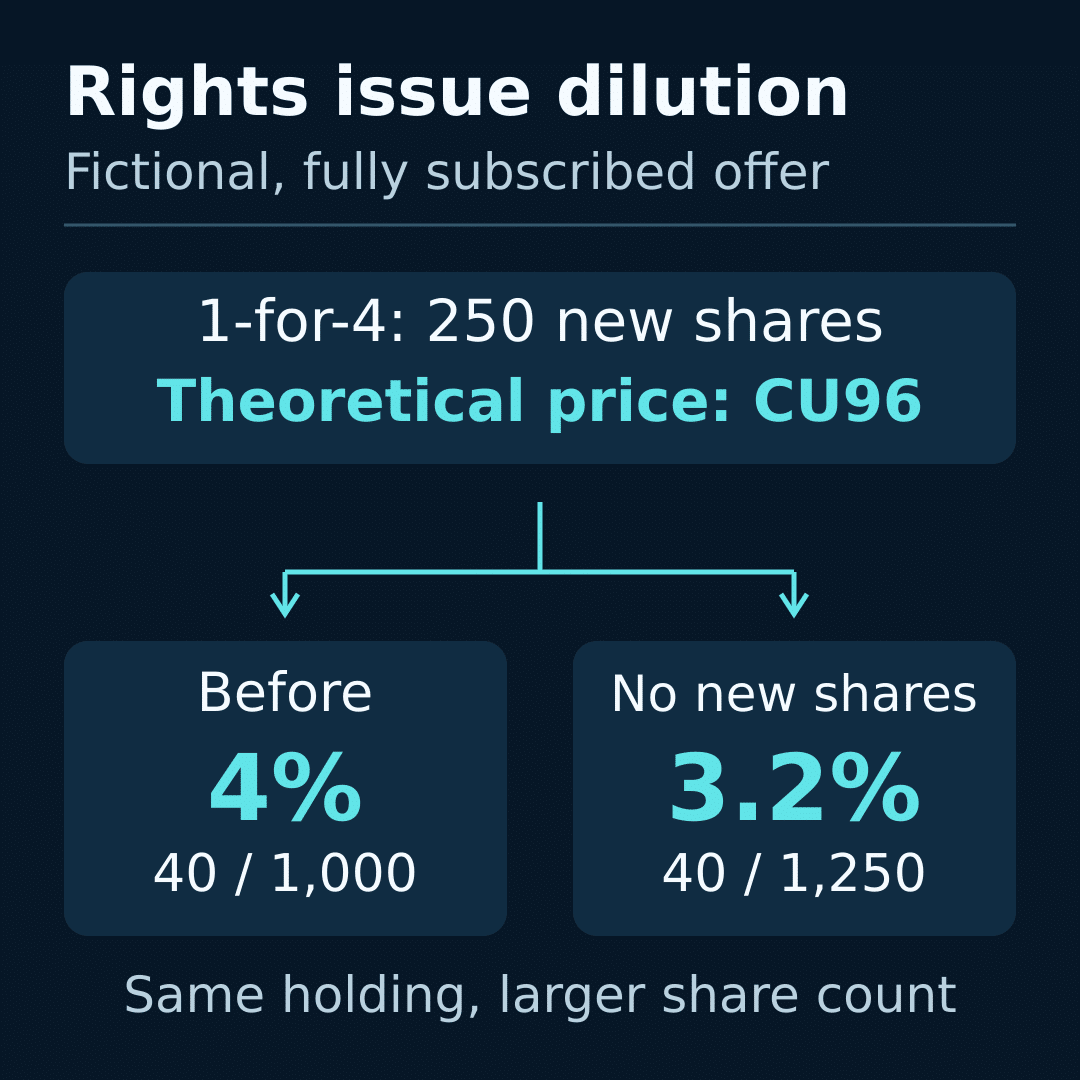
The holder starts with 40 of 1,000 shares, or 4%, worth CU4,000 at the original reference price. The offer provides entitlement to ten new shares. In every branch below, assume the company still completes the full 250-share issue.
Subscribe: the holder contributes ten × CU80 = CU800 and ends with 50 shares. Ownership remains 50 ÷ 1,250 = 4%. The theoretical holding value is 50 × CU96 = CU4,800. That equals the initial CU4,000 plus the added CU800; the increase in the holding value must be read alongside the cash contribution.
Sell transferable entitlements: assume the terms permit transfer and all ten entitlements could be sold at the theoretical CU16 each, before costs. The holder retains 40 shares worth CU3,840 and receives CU160. Their combined reference value is CU4,000, while ownership falls to 40 ÷ 1,250 = 3.2%.
Allow entitlements to lapse: the holder again retains 40 shares, representing 3.2% and a theoretical CU3,840. No subscription cash is contributed and no entitlement-sale proceeds are received. The CU160 difference from the initial reference illustrates the value forgone under the model’s assumptions.
The move from 4% to 3.2% is a decline of 0.8 percentage points, or 20% of the original ownership percentage. Selling entitlements and preserving an ownership percentage are therefore different outcomes. Neither description should be collapsed into an unexplained “dilution” figure.
Use the offer document to test the model’s assumptions
For an actual document, record the exact issuer and security, ratio, subscription price, offer size, payment schedule, transferability, fractional treatment and relevant dates. Read the stated use of proceeds and risks. These details determine whether the simplified example even fits the offer.
Use the market-news verification checklist to trace a summary back to the issuer or exchange notice. A screenshot that shows only a price and ratio leaves important questions open.
Save the share-count bridge, cash assumptions and unresolved terms with a market research journal. The useful end product is a reproducible description of the capital change, with theoretical values clearly distinguished from observed prices and actual transaction records.
Frequently asked questions
Is a rights issue the same as a bonus issue?
No. The model here requires new subscription cash: CU20,000 enters the company. A bonus issue does not involve that same subscription contribution. Check the corporate-action label before reusing a share-count or price-adjustment calculation.
Does one-for-four mean four new shares for each old share?
It means one new share offered for four eligible existing shares. In the example, 40 old shares produce entitlement to ten new shares. Restating the ratio in a sentence helps catch a reversed numerator and denominator.
What if the ratio produces a fractional entitlement?
The fictional 40-share holding produces exactly ten entitlements, but 41 divided by four is 10.25. The actual offer determines how fractions are handled. Preserve the unrounded calculation, then record the issuer’s stated treatment before deriving the final entitlement.
If I buy an entitlement on NSE, do I automatically receive the share?
NSE’s FAQ says no: buying the entitlement must be followed by the required subscription application within the offer. Entitlements bought but not used can lapse without delivering shares. Read the specific offer terms rather than assuming automatic conversion.
Why is the theoretical ex-right price below the old price?
The fictional issue adds 250 shares at CU80 to 1,000 shares referenced at CU100. Combining CU120,000 across 1,250 shares gives CU96. The lower theoretical per-share number accompanies additional shares and cash in this model.
Is the theoretical price the price the market must use?
No. CU96 follows from fixed illustrative inputs and exclusions. It is useful for understanding the mechanism, but it does not constrain the next traded price. Preserve the calculation date and assumptions separately from actual market observations.
Can my ownership percentage fall even if I sell the rights?
Yes. The sale branch leaves the holder with 40 of 1,250 shares, or 3.2%. Hypothetical CU160 entitlement proceeds help explain the value bridge, but those proceeds do not add shares to the holder’s ownership numerator.
Does a rights issue necessarily reduce earnings per share?
The number of shares changes, but future earnings can also change. This example contains no earnings forecast and cannot establish an EPS outcome. An EPS analysis would require matching earnings and the appropriate share basis.
Are rights always transferable?
Transferability is an offer-specific condition that must be checked. The sale branch deliberately assumes it, along with a sale at the theoretical value. If transfer is unavailable, that branch is not an available description of the actual offer.
What changes if the offered shares are partly paid?
The payment schedule and any later calls become essential inputs, along with the share class and its terms. The example assumes CU80 fully pays each new share; reusing it unchanged would omit a material future payment component.
Sources checked 13 October 2026. Educational content only. All numerical examples are fictional and are not current market data or investment recommendations.