

By CrowdSent Blog Team
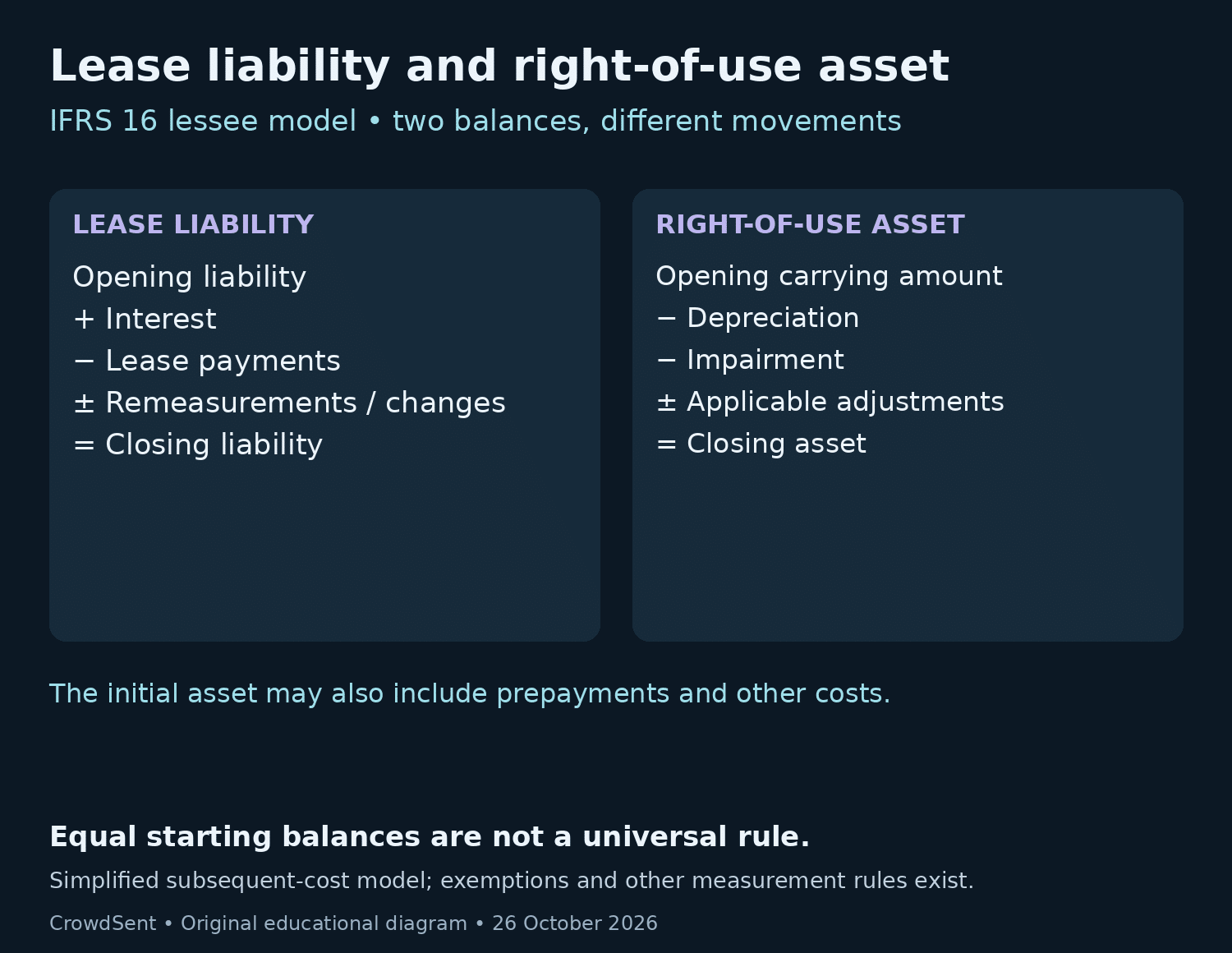
A lease liability records the measured obligation to make lease payments; a right-of-use asset records the right to use the leased item. They can begin at the same amount and then follow different paths. Comparing their closing balances without examining those paths can make a perfectly consistent set of accounts look contradictory.
This guide uses a simplified lessee example under IFRS 16. It follows one contract through three years, separating cash payments from interest and depreciation. It does not decide whether leasing is preferable to buying, or prescribe how every country’s accounts must be prepared.
Lease liability and right-of-use asset answer different questions
The IFRS Foundation’s IFRS 16 overview explains the lessee recognition model and the availability of exemptions for qualifying short-term and low-value leases. For a lease within the model, the liability concerns payments and the asset concerns use. Legal ownership of the underlying equipment need not transfer.
First identify the reporting framework and which party’s accounts you are reading. The customer using the asset is the lessee. The supplier granting that right is the lessor. A lessor’s accounting should not be reconstructed by simply copying the two balances in this example.
Set the payment dates before calculating present value
Imagine fictional Maple Services leases equipment for exactly three years. Payments of 11,000 currency units fall at each year-end. The relevant annual discount rate is assumed to be 10%. There is no payment at commencement, purchase option, transfer of ownership, incentive, initial direct cost, restoration obligation or modification. The useful period of the right is three years, and straight-line depreciation is appropriate.
The initial liability is 11,000 ÷ 1.10 + 11,000 ÷ 1.10² + 11,000 ÷ 1.10³ = 27,355.37. The undiscounted payments total 33,000. The difference of 5,644.63 is the total interest that the simplified schedule will recognise over the term.
Those figures answer different questions. The 33,000 is the sum of the scheduled payments. The 27,355.37 reflects their present value using the stipulated rate and dates. Neither figure is a quotation for buying the equipment outright.
For an actual contract, the rate is not chosen merely because it makes the worksheet convenient. IFRS 16 uses the implicit rate when readily determinable, otherwise the lessee’s incremental borrowing rate. The Australian standard-setter’s published lessee requirements, paragraphs 24–36, also set out the initial cost adjustments and subsequent measurement mechanics used here.
Follow the lease liability through three payments
For each year, add interest on the opening balance and deduct the cash payment. Interest is calculated before the year-end payment because Maple has the use of the financing throughout that year.
| Year | Opening liability | Interest | Payment | Closing liability |
|---|---|---|---|---|
| 1 | 27,355.37 | 2,735.54 | 11,000.00 | 19,090.91 |
| 2 | 19,090.91 | 1,909.09 | 11,000.00 | 10,000.00 |
| 3 | 10,000.00 | 1,000.00 | 11,000.00 | 0.00 |
In year one, only 8,264.46 of the 11,000 payment reduces the opening principal balance. The other 2,735.54 offsets that year’s interest addition. Subtracting 11,000 directly from the opening liability without first accounting for interest would understate the closing balance.
Notice that the annual payment stays constant while interest falls. The remaining liability is smaller each year, so the same 10% rate produces less interest. This arithmetic does not indicate that the contractual rate was renegotiated.
Keep the asset in a separate worksheet
Under our deliberately limited starting assumptions, the asset also begins at 27,355.37. Allocating that amount over three years gives approximately 9,118.46 annual depreciation, with a small final rounding adjustment. Closing asset values are 18,236.91 after year one, 9,118.45 after year two and zero after year three.
At the first year-end, the liability is 19,090.91 but the asset is 18,236.91. Their difference is 854.00. Nothing is missing: one schedule follows financing and payments; the other allocates the cost of use. The difference disappears by the end under these assumptions.
Year-one interest plus depreciation is approximately 11,854.00, compared with cash paid of 11,000. In year three, the corresponding total is approximately 10,118.45. Across all three years the combined expense equals the 33,000 payments, although the annual timing differs. These are expense amounts for this example; other circumstances may require costs to enter another asset’s carrying amount.
The capital expenditure versus depreciation guide explains allocation over time more broadly. Here the distinctive issue is keeping that allocation separate from the lease payment schedule.
Read real disclosures without forcing the example onto them
A real right-of-use asset can start above or below the liability because of qualifying initial costs, prepayments, incentives and other required adjustments. Later changes can include impairment or remeasurement. Our clean three-year pattern is therefore a diagnostic teaching example, not an expectation that every annual report will show matching opening numbers.
When examining a company, make two short reconciliations with separate columns. For the liability, identify opening balance, additions, interest, payments and other disclosed movements. For the asset, identify opening carrying amount, additions, depreciation, impairment and other adjustments. Label any unexplained residual instead of assigning it to cash.
Then connect the notes to the financial statements as a whole. A new lease can increase reported assets and obligations without an equal day-one cash payment. A repayment reduces cash even when the related asset’s depreciation appears elsewhere.
Finally, do not automatically add the lease liability twice when constructing a valuation bridge. The enterprise value versus market cap guide deals with that separate convention. First understand the accounting balance, then check how a chosen valuation methodology treats it.
Frequently asked questions
Is a lease liability the same as unpaid rent?
Not necessarily. In this example it is a discounted balance for multiple future payments, rather than one overdue invoice. Check the payment schedule and measurement basis before describing the balance as arrears.
Why is the initial liability below 33,000?
The three payments occur in the future. Discounting each payment at the assumed positive rate gives 27,355.37 today. Adding undiscounted payments instead would omit the timing assumption built into the measurement.
Why do the asset and liability diverge?
Maple depreciates the asset evenly, while its liability falls through payments after interest is added. Those different calculations produce different interim balances even though both reach zero at the end.
Does depreciation reduce the lease liability?
No. In the worksheet, depreciation reduces the asset carrying amount. The liability changes through its own interest and payment entries. Applying depreciation to both balances would double count the reduction.
Can the asset start at a different amount?
Yes. For example, a qualifying payment made at commencement can affect asset cost while no longer being part of unpaid future payments. Trace each initial adjustment rather than assuming the asset must equal the liability.
Is the 10% rate a recommended assumption?
No. It was selected to make a fictional calculation transparent. A real report needs its applicable measurement requirements and supportable inputs; this example provides no estimate of any company’s borrowing rate.
What changes if payments are made at the beginning of each year?
The dates and opening unpaid balance change. An immediate payment is not discounted as though it occurs a year later. Rebuild the timeline rather than reusing this end-of-year schedule.
Must every short lease produce these two balances?
No. IFRS 16 contains recognition exemptions subject to conditions and elections. A small payment alone does not establish eligibility. Read the company’s stated policy and relevant contract details.
Does a lower asset balance mean the lease is cheaper?
The carrying amount alone does not answer that. It reflects accounting movements under the selected model. Comparing economic cost also requires the contract’s dates, payments, services and other terms.
What is the quickest way to check the worksheet?
Reconcile opening liability plus total interest minus payments to zero, then reconcile initial asset less total depreciation to zero. Use unrounded calculations internally and explain the final rounding adjustment.
Explore CrowdSent and its current membership options for more information about the service.
Educational information only, not investment, accounting or tax advice. Sources checked 26 October 2026.