

GDP vs GNI asks whether the focus is domestic production or the primary income accruing to an economy’s residents. Gross domestic product measures production within the domestic economic framework. Gross national income adjusts that picture for primary income receivable from, and payable to, the rest of the world.
National in this context concerns economic residence. It should not be casually translated into passport nationality, the location of a bank account or the nationality of a brand. Those shortcuts can put the same income on the wrong side of a GDP vs GNI comparison.
GDP vs GNI: write the income bridge with both directions
In the standard reconciled national-accounts relationship, GNI equals GDP plus primary income received from abroad minus primary income paid abroad. Eurostat’s GNI overview describes the cross-border income flows, including employee compensation, interest, dividends and reinvested earnings.
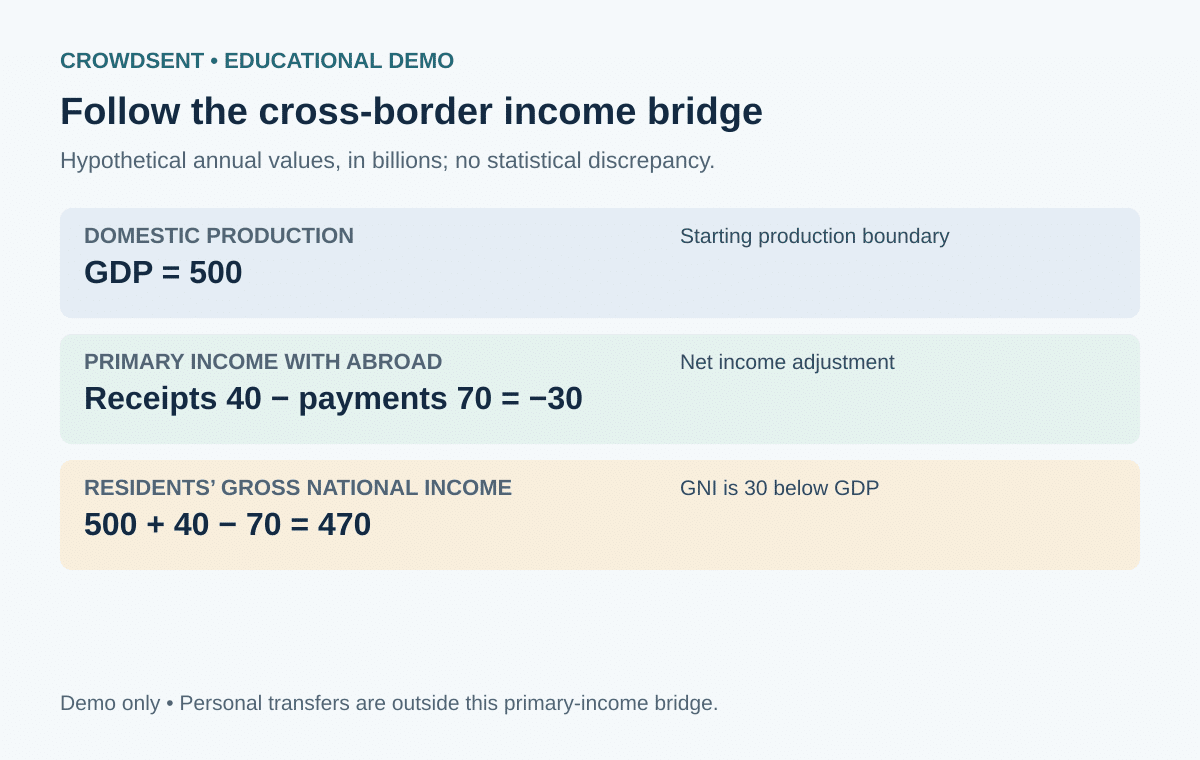
Suppose a hypothetical economy has annual GDP of 500 billion currency units. Its residents receive 40 billion of primary income from nonresidents, while 70 billion is payable to nonresidents. Net primary income from abroad is minus 30 billion. GNI is therefore 470 billion: 500 plus 40 minus 70.
The 30 billion difference equals 6 percent of GDP. It does not mean 6 percent of domestic production vanished. It describes the net income adjustment between the domestic production measure and the residents’ income measure under these assumptions.
Separate a foreign-owned factory from foreign income
Imagine a resident factory with foreign owners. Its annual sales are 100, and its intermediate inputs cost 60, leaving value added of 40. Assume this simplified value added consists entirely of 25 in compensation to resident workers and 15 in earnings attributable to nonresident owners. Ignore taxes, depreciation and other claims for this demonstration.
The factory’s domestic value added is 40 regardless of the owners’ residence. In this isolated example, the 15 of primary income attributable abroad is subtracted in moving toward national income. The remaining 25 accrues to resident workers. Subtracting the factory’s entire 100 of sales, or even its entire 40 of value added, would remove too much.
The reverse case also requires care. If residents hold an investment in a foreign enterprise, do not add that enterprise’s entire foreign output to their home country’s GNI. Identify the primary income attributable to the resident investors under the accounts.
Use residence and the right income category
The OECD’s GNI definition describes compensation earned abroad by residents, including some border and seasonal workers whose economic center remains at home. It also includes relevant property income and net production-tax and subsidy flows with the rest of the world.
For example, a worker living in one economy and commuting into another can produce output in the workplace economy while earning income attributable to the home economy’s residents. A citizen who has become economically resident abroad is a different case. The statistical residence classification must be established before assigning the income.
Property income can include reinvested earnings associated with foreign direct investment. A cash transfer into a domestic bank is therefore not required for every income entry. Conversely, moving an existing deposit between one’s own accounts does not automatically create new national income.
Keep transfers outside the primary-income bridge
Suppose, separately, resident households receive eight billion as personal transfers from relatives who are resident abroad. These transfers should not simply be added to the 40 billion of primary-income receipts above. The World Bank’s account classification places personal transfers in secondary income, separate from compensation earned by a cross-border worker.
Statistics Netherlands explains the disposable-income bridge. Under a simplified example with no other current transfers, adding that net eight to GNI of 470 would produce gross national disposable income of 478. The GNI figure itself remains 470. The distinction matters because family support and income earned from production are different accounting flows.
Broad remittance indicators can combine transfers and employee compensation. The World Bank’s remittance metadata makes that composition explicit. Adding an entire remittance aggregate to GDP risks including transfers in the wrong bridge and counting some compensation twice.
Check the publisher’s reconciliation convention
The GDP vs GNI examples assume the domestic expenditure and income measures agree. US BEA tables preserve a statistical discrepancy between them. BEA’s national-accounts primer calculates GNI from GDI plus net income from abroad. GDP plus the same net income corresponds to the companion GNP measure. When reconciling actual US published levels, retain the discrepancy instead of forcing the simplified identity onto unlike totals.
Also retain the currency and valuation method. The World Bank explains that its income classifications use Atlas-method GNI per capita. A current-dollar, purchasing-power-parity or constant-price series can answer a different comparison question. A country ranking without those labels is incomplete.
GDP vs GNI: common questions
1. Can GNI be larger than GDP?
Yes. In a reconciled framework, positive net primary income from abroad raises GNI above GDP. Negative net primary income lowers it, as in the 500-to-470 example.
2. Does national mean income earned only by citizens?
No. Economic residence governs this boundary. Citizenship alone cannot determine whether a person or enterprise is resident in the statistical economy.
3. Does foreign ownership remove a factory from domestic GDP?
No. A resident producer’s domestic value added belongs in GDP. Primary income attributable to nonresident owners is considered separately in the national-income adjustment.
4. Are reinvested foreign earnings excluded until cash arrives?
Not necessarily. Relevant reinvested earnings can be recorded as primary income under direct-investment accounting even when they remain within the foreign enterprise.
5. Is money sent to relatives always employee compensation?
No. A transfer by a person resident abroad to a resident household is different from compensation earned abroad by a worker who remains resident at home.
6. Does the gross in GNI mean taxes have not been paid?
Gross refers to the measure before deducting consumption of fixed capital. It does not mean GNI is a single household’s pretax salary or available cash balance.
7. Is GNI per capita a typical person’s income?
It is an economy-wide average per person. It does not show the median, income distribution, household composition or the share immediately available for household spending.
8. Can a foreign share-price gain be added as investment income?
A holding gain is different from primary income such as dividends. A rise in an asset’s market price should not automatically be inserted into the GDP-to-GNI bridge.
9. Why might US GDP plus net foreign income differ from published GNI?
BEA’s GNI bridge starts with GDI. The statistical discrepancy separating GDP from GDI must therefore be retained when reconciling the published US measures.
10. What should I save for a GDP-GNI comparison?
Keep the country, year, currency, price basis, data vintage, receipts, payments and publisher’s reconciliation convention. Label any per-capita or purchasing-power conversion separately.
Educational note: All numerical examples are hypothetical demonstrations. This article explains economic statistics and does not provide investment advice or predict market returns.
Explore CrowdSent membership.
Keep the source date, units, reporting boundary and calculations together in a market research journal so later comparisons can be reproduced.