

A deferred tax asset represents recognised future tax benefits, subject to accounting recognition conditions. A deferred tax liability represents recognised future tax consequences that increase tax payable as relevant differences reverse. Neither figure is simply the current tax bill, and a deferred tax asset is not automatically a cash refund waiting to arrive.
This guide follows two original, fictional timing examples under the IFRS framework. The 25% rate and deduction rules are assumptions, not statements of tax law in India, Pakistan, the United States or any other jurisdiction. The aim is to connect carrying amounts, tax bases and tax expense without offering tax-planning advice.
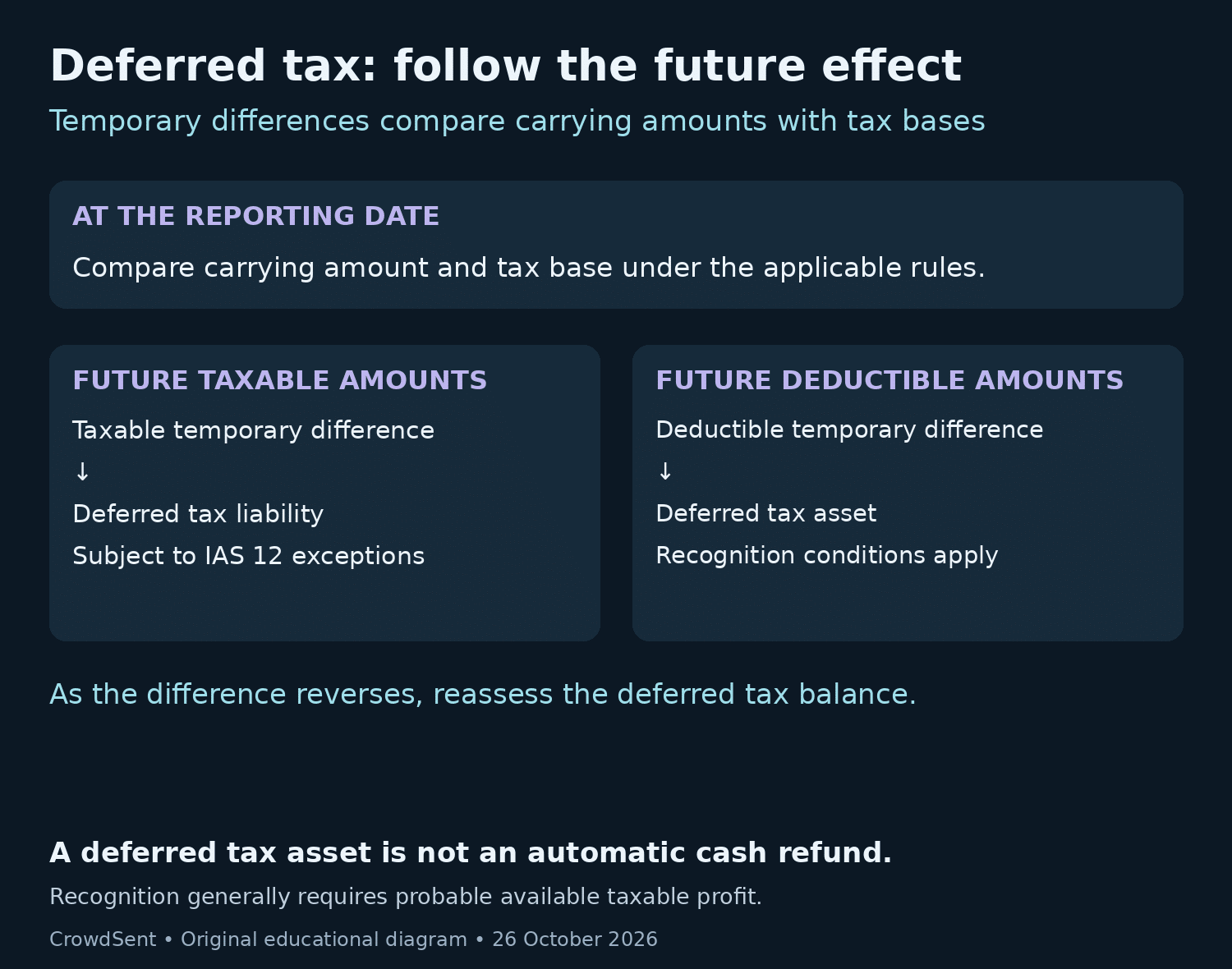
Deferred tax asset vs liability: start with the tax base
A carrying amount is the amount an asset or liability has in the financial statements. Its tax base is the amount attributed to it for tax purposes. Differences that have future tax consequences are temporary differences. Their direction, applicable rules and recognition conditions determine whether deferred tax arises.
The IFRS Foundation’s IAS 12 overview distinguishes current tax from deferred tax and explains temporary differences. It also notes that specific exceptions apply. A simple multiplication is therefore the last step after classification, not a substitute for understanding the underlying balance.
For statement context, read financial statements explained. Keep three columns in your worksheet: current tax for the period, movement in deferred tax, and total tax expense. A fourth column for actual cash payments prevents the tax liability from being mistaken for a bank transaction.
Example one: recognise a deductible warranty difference
Fictional company Rowan earns 50,000 currency units before warranty expense and tax in Year 1. It records a 12,000 warranty expense and liability for products already sold. Assume the expense becomes deductible for tax only when repairs are paid in Year 2.
Year 1 accounting profit before tax is 50,000 − 12,000 = 38,000. Taxable profit remains 50,000 because the deduction has not yet become available. At the assumed 25% rate, current tax is 12,500.
The warranty liability has a carrying amount of 12,000. Under these assumptions its tax base is zero: its carrying amount less the 12,000 future deduction. The resulting deductible temporary difference is 12,000. Assume sufficient taxable profit will probably be available in the appropriate period and jurisdiction and that no recognition exception applies.
The recognised deferred tax asset is 12,000 × 25% = 3,000. Its initial recognition creates a 3,000 deferred tax benefit in this example. Total Year 1 tax expense is current tax of 12,500 less that benefit of 3,000, giving 9,500. This equals 25% of accounting profit of 38,000 under the deliberately simplified assumptions.
Reverse the difference in Year 2
In Year 2, Rowan earns another 50,000 before tax and pays the 12,000 warranty obligation. Assume no new warranty expense, no change in estimates and no other differences. The payment settles the liability recorded in Year 1, so it does not create another warranty expense in Year 2.
Accounting profit before tax is 50,000. Taxable profit is 50,000 − 12,000 = 38,000 because the assumed deduction is now available. Current tax is 9,500. The warranty liability and its temporary difference both fall to zero, so the 3,000 deferred tax asset reverses.
Year 2 tax expense is current tax of 9,500 plus deferred tax expense of 3,000, giving 12,500. Across both years, current tax totals 22,000 and total tax expense also totals 22,000. The deferred asset changes when the tax effect is recognised in the accounts; it does not manufacture an additional lifetime deduction.
| Measure | Year 1 | Year 2 |
|---|---|---|
| Accounting profit before tax | 38,000 | 50,000 |
| Taxable profit | 50,000 | 38,000 |
| Current tax | 12,500 | 9,500 |
| Deferred tax expense / (benefit) | (3,000) | 3,000 |
| Total tax expense | 9,500 | 12,500 |
| Closing deferred tax asset | 3,000 | 0 |
No tax-payment schedule is assumed here. Current tax expense or a tax liability need not equal cash paid during that same period. The accrual versus cash accounting guide explains the broader timing distinction.
Example two: follow a taxable asset difference
Now consider a separate fictional machine costing 20,000. Assume accounting depreciation of 10,000 in each of two years, but tax deductions of 15,000 in Year 1 and 5,000 in Year 2. There is no residual value, impairment or other adjustment.
At the end of Year 1, the carrying amount is 10,000 and the tax base is 5,000. The company has 10,000 of accounting value left to recover but only 5,000 of future deductions under the assumed tax rules. The taxable temporary difference is 5,000 and the deferred tax liability is 1,250 at 25%.
At the end of Year 2, both amounts are zero. The temporary difference and the 1,250 liability reverse. The total machine cost deducted over two years remains 20,000 in both calculations; only its allocation between years differs. For the asset-side mechanics, see capital expenditure versus depreciation.
This machine case and Rowan’s warranty case are separate examples. Do not net their deferred balances as if they belonged to one taxpayer. Actual offsetting requires conditions beyond merely having both an asset and a liability on a worksheet.
Recognition and measurement are separate checks
Identifying a possible benefit does not automatically justify recognising the full deferred tax asset. Future taxable-profit availability matters. Loss history, expiry restrictions and the relevant tax rules need attention when assessing whether the benefit can be used.
For example, if only 8,000 of Rowan’s 12,000 deduction met the recognition conditions, the recognised asset would be 2,000 at the assumed rate, not 3,000. That alternative changes the initial accounting benefit without changing the amount of the warranty obligation.
Measurement uses the rate expected when the difference reverses, based on legislation enacted or substantively enacted by the reporting date. The IAS 12 issued text provides the detailed recognition and measurement requirements; access may require an IFRS account or subscription. Our constant rate avoids forecasting a real country’s legislation.
Deferred tax asset: frequently asked questions
Is a deferred tax asset a guaranteed refund?
No. Rowan’s asset represents a future deduction reducing taxable profit under the assumptions. The example contains no entitlement to receive a separate 3,000 cash refund.
Why does Rowan pay attention to future taxable profit?
A deduction is useful only where the applicable rules permit it to be used. Recognition therefore needs support beyond multiplying an available deduction by a tax rate.
Why is Year 1 current tax higher than total tax expense?
Rowan cannot yet use the warranty deduction for current tax. Recognising the 3,000 future benefit reduces accounting tax expense from 12,500 to 9,500.
Does reversing the asset mean it failed?
Not in this example. The asset reverses because Rowan receives the assumed deduction in Year 2. That expected use is different from reducing an asset because recovery is no longer supported.
Is the machine’s tax base its market value?
No. The 5,000 tax base comes from remaining tax deductions in the fictional schedule. No sale price or independent valuation was used to calculate it.
Do all accounting and taxable-profit differences reverse?
No. A permanently non-deductible item is different from an expense deductible later. Establish the future tax consequence before labelling a difference temporary or calculating deferred tax.
Can unused tax losses create a deferred tax asset?
They can, subject to recognition conditions and applicable tax restrictions. A loss does not automatically create an asset equal to the loss multiplied by the headline tax rate.
Can I use this article’s 25% rate for a real company?
No. It is a teaching assumption. A real calculation requires the relevant jurisdiction, enacted or substantively enacted rules, reversal circumstances and reporting-date evidence.
Can I subtract every deferred tax liability from every asset?
No. Separate taxpayers, authorities and legal conditions matter. Keep gross balances visible until you have verified whether the report’s offsetting conditions are satisfied.
What should I check first in a tax note?
Identify the underlying differences, opening and closing deferred balances, recognised and unrecognised benefits, and the current/deferred expense split. Then distinguish those figures from actual tax payments.
Explore CrowdSent’s current membership information for wider market research. Use the company’s original tax note for its reported balances.
Educational information only, not tax, accounting or investment advice. All figures, deduction rules and companies in the examples are fictional.