

Current ratio vs quick ratio asks how much of a company’s short-term asset coverage depends on inventory and other assets excluded from the narrower measure. Both use current liabilities as the denominator. Their difference can reveal where to investigate, but neither calculates exactly when cash will arrive.
A reliable current ratio vs quick ratio comparison starts with one reporting date and an explicit formula. Using a year-end asset number with liabilities from a later quarter creates a ratio that does not describe either balance sheet.
Current Ratio vs Quick Ratio: choose the definitions before calculating
The CFA Institute financial ratio list defines the current ratio as current assets divided by current liabilities. Its quick ratio uses cash, short-term marketable investments and receivables over the same denominator. This article follows that definition, with eligible cash equivalents grouped with cash and receivables stated net of allowances.
Inventory and prepaid expenses are therefore included in the current-asset total but excluded from the quick numerator. Removing inventory alone may be insufficient if the current-asset section contains prepayments or other items that do not meet the chosen quick-asset definition.
A data provider or loan agreement may use its own adjustments. Record those adjustments rather than silently substituting a familiar formula. A covenant calculation especially needs the agreement’s terms, even when the label looks identical.
Calculate both ratios from one balance sheet
Suppose a hypothetical company has $30,000 cash, $10,000 short-term marketable investments, $80,000 net receivables, $100,000 inventory and $20,000 prepaid expenses. Current assets total $240,000. Current liabilities are $120,000.
The current ratio is $240,000 divided by $120,000, or 2.00. The quick numerator is $30,000 plus $10,000 plus $80,000, or $120,000. Dividing by the same liabilities gives a quick ratio of 1.00.
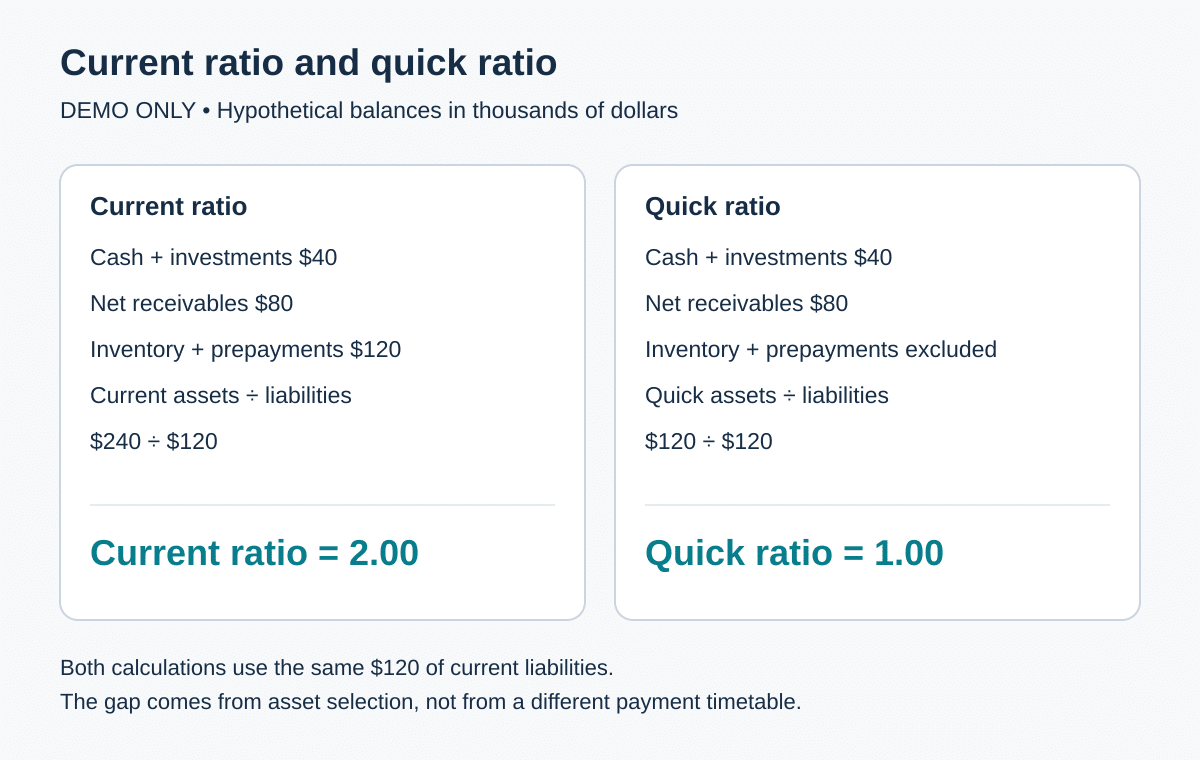
The difference is exactly 1.00 ratio point: the excluded $120,000 divided by current liabilities of $120,000. This gap is a useful reconciliation, not an additional independent cash reserve. The company cannot add the two ratios to obtain total coverage.
Understand what a payment does to the comparison
Starting from those balances, imagine paying $20,000 of an existing current liability using cash. Current assets become $220,000 and current liabilities become $100,000. The current ratio rises to 2.20. Quick assets fall to $100,000, leaving the quick ratio at 1.00.
Cash has fallen from $30,000 to $10,000 even though the current ratio increased. The arithmetic reflects equal reductions in a numerator and denominator that initially differed in size. It does not establish that the business gained flexibility for a different payment due tomorrow.
In a separate scenario from the original balance sheet, purchasing $10,000 inventory for cash leaves total current assets unchanged. The current ratio stays 2.00. Quick assets fall to $110,000, so the quick ratio becomes approximately 0.92. The narrower ratio detects the shift away from quick assets.
Check whether the included assets can deliver cash
Quick assets still need examination. A receivable may be disputed, overdue or concentrated in one customer. A marketable investment may have settlement constraints, price changes or restrictions. A classification does not guarantee that every included dollar can meet every current obligation on demand.
The SEC’s financial-statement guide explains that a balance sheet is a snapshot, while cash-flow information covers a period. That distinction matters here: ratios summarize balances, whereas a payment forecast places expected receipts and obligations on dates.
For example, assume $60,000 of the example’s receivables is due in 75 days while $50,000 of liabilities must be paid within a week. The quick ratio’s 1.00 reading does not reveal this mismatch. The analyst needs the collection schedule, due dates and any available funding disclosures.
Compare businesses with similar operating patterns
Inventory-heavy businesses and service businesses naturally have different asset mixes. Even two retailers can differ in stock turnover, supplier terms and seasonal purchasing. Compare like reporting dates and explain the operating model before interpreting a gap as improvement or deterioration.
A higher current ratio can arise from accumulated unsold inventory. A lower one can arise when a previously recorded bill is paid, depending on the starting ratio. Neither movement carries a universal verdict. Inspect the transactions and the quality of the assets involved.
A current ratio vs quick ratio review retains both numerators, the shared denominator, the excluded items and their change since the previous comparable period. Add aging and restriction notes where material. This makes the analysis more useful than assigning a company a pass or fail from a single threshold.
Current ratio vs quick ratio: common questions
1. Why is the quick ratio sometimes called the acid-test ratio?
The terms commonly refer to the same narrower liquidity measure. Still verify the actual inputs, because conventions and contractual definitions can differ.
2. Is the current ratio expressed as a percentage?
It is commonly stated as a multiple, such as 2.00 or 2:1. That means two dollars of included current assets per dollar of current liabilities.
3. Should prepaid expenses count as quick assets?
They are excluded under the definition used here because prepaid benefits generally cannot be redirected as cash to settle another bill.
4. Are receivables automatically as liquid as cash?
No. Their usefulness depends on collectability, expected payment dates and restrictions. Net receivables also reflect allowances that should be reviewed.
5. Can the quick ratio exceed the current ratio?
With the same positive liability denominator and quick assets that are a subset of current assets, it cannot. An apparent exception warrants checking definitions or source data.
6. What if current liabilities are zero?
Division by zero is undefined. Do not replace the missing ratio with an arbitrary large number; describe the balances and consider other liquidity information.
7. Does a quick ratio of 1 guarantee timely payment?
No. It says included assets equal current liabilities at the measurement date. It does not align settlement dates or guarantee collection.
8. Can paying bills increase the current ratio?
Yes. In the example, paying $20,000 changes the ratio from 2.00 to 2.20 even as cash falls. Numerator and denominator mechanics explain the increase.
9. Why might a quarterly comparison be misleading?
Seasonal stock purchases, customer collections or debt maturities may change the balances. Compare the same seasonal period and inspect intervening transactions.
10. Which ratio should be used in a debt covenant?
Use the definition in the relevant agreement, including permitted exclusions and adjustments. A general educational formula does not determine contractual compliance.
Educational note: This article explains financial-statement analysis, not investment advice. All company figures are hypothetical. Ratios and cash-flow measures do not predict share prices or guarantee financial outcomes.
Explore CrowdSent membership.
Keep the source date, units, reporting boundary and calculations together in a market research journal so later comparisons can be reproduced.